

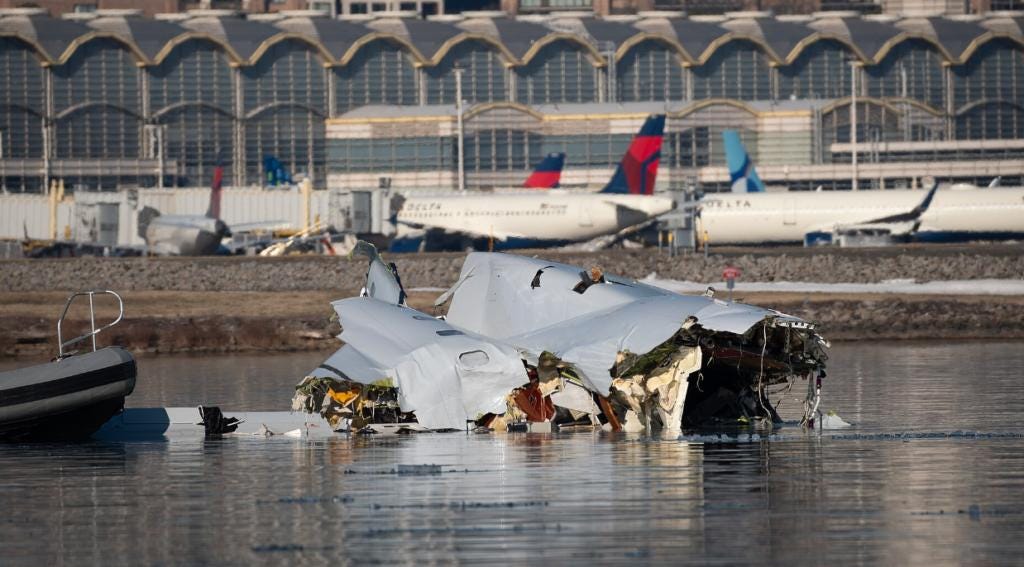
A U.S. Army investigation has identified a series of systemic failures that contributed to the January 2025 midair collision between an Army Black Hawk helicopter and American Airlines Flight 5342 near Ronald Reagan Washington National Airport, a disaster that killed all 67 people aboard the two aircraft.
The Army’s report, completed in May and later provided to families of the victims, largely supports findings from the National Transportation Safety Board while detailing additional shortcomings within the military’s aviation system. The report has not been publicly released in full, and portions provided to families remain redacted.
Communication failures emerged as a central factor
According to the Army investigation, two broken radio transmissions were among the most significant factors in the crash. The communications problems contributed to the helicopter crew not receiving or identifying critical information about Flight 5342 as the aircraft approached Reagan National.
The helicopter was operating in an exceptionally congested area of airspace, where military aircraft routinely operate close to commercial traffic. The route used by the Black Hawk provided only about 75 feet of vertical separation from the approach path used by commercial aircraft.
The Army also faulted air traffic control for incomplete traffic advisories and the use of nonstandard terminology. Investigators concluded that more specific information about the approaching jet could have helped the helicopter crew identify the threat.
The NTSB’s broader investigation similarly found that the airspace configuration around Reagan National created significant collision risks and that air traffic control procedures failed to adequately manage those risks.
Faulty altitude information added another layer of risk
The Army investigation also examined problems with barometric altimeters installed on older Black Hawk helicopters.
The helicopter involved in the crash was indicating an altitude of roughly 200 feet even though investigators determined it was actually about 278 feet above the Potomac River. The Army had known about accuracy problems with some of these instruments but had not adequately ensured that crews understood the potential magnitude of the errors.
The aircraft’s configuration, including additional fuel tanks, could further affect altitude readings.
The Army has since issued additional safety guidance and undertaken inspections, but a broader update addressing the altimeter issue is not expected to appear in operator manuals until 2027, according to reporting on the investigation.
Night-vision goggles and missing technology
Investigators also determined that night-vision goggles may have made it harder for the Black Hawk crew to distinguish the approaching passenger jet from surrounding city lights.
The Army report further identified shortcomings involving aircraft tracking and collision-avoidance technology. The Black Hawk was not transmitting ADS-B Out location information because of a maintenance issue, while many Army helicopters lacked Traffic Alert and Collision Avoidance Systems capable of providing additional protection.
The NTSB previously concluded that technological limitations prevented either aircraft from receiving an effective warning that could have prevented the collision. It recommended improvements involving collision avoidance, data sharing, helicopter route design and aviation safety management.
Safety culture and training also came under scrutiny
The Army investigation found weaknesses extending beyond the aircraft and air traffic control system.
Investigators identified insufficient pilot training for operating in complex civilian airspace, shortcomings in the collection and review of near-miss information and inadequate coordination between the Army and the FAA.
The Army lacked a formal system for consistently identifying and reporting near misses, while an interagency working group operating in the Washington region did not adequately examine airspace violations and close encounters before the crash.
The report recommends that the Army examine helicopter operations in other major metropolitan areas to determine whether similar hazards exist. Reviews are already underway in areas including Los Angeles and the Seattle-Tacoma region, according to an Army official.
Families call for mandatory collision-avoidance technology
The new findings are likely to add pressure on Congress to advance aviation safety legislation.
Families of Flight 5342 victims have urged lawmakers to require aircraft operating in congested airspace to use technology that allows pilots and aircraft systems to better detect nearby traffic.
The House and Senate have passed different aviation safety measures, leaving lawmakers to negotiate a final bill. The families argue that the technology needed to reduce the risk of another collision already exists and that the remaining question is whether Congress will require its use.
The Army says it has already taken steps to strengthen training, aircraft inspections, altitude-awareness procedures and safety monitoring. The NTSB has acknowledged significant progress by the Army on most of its recommendations, while continuing to press for additional improvements.
The January 29, 2025, collision remains one of the deadliest aviation disasters in modern U.S. history. The NTSB concluded earlier this year that failures involving the FAA, Army safety management, airspace design, air traffic control and collision-avoidance capabilities combined to create the conditions for the tragedy.
The Army’s latest investigation adds another layer to that accounting, showing that the disaster was not the result of a single mistake but a chain of weaknesses that went undetected or unresolved across multiple parts of the aviation system.