

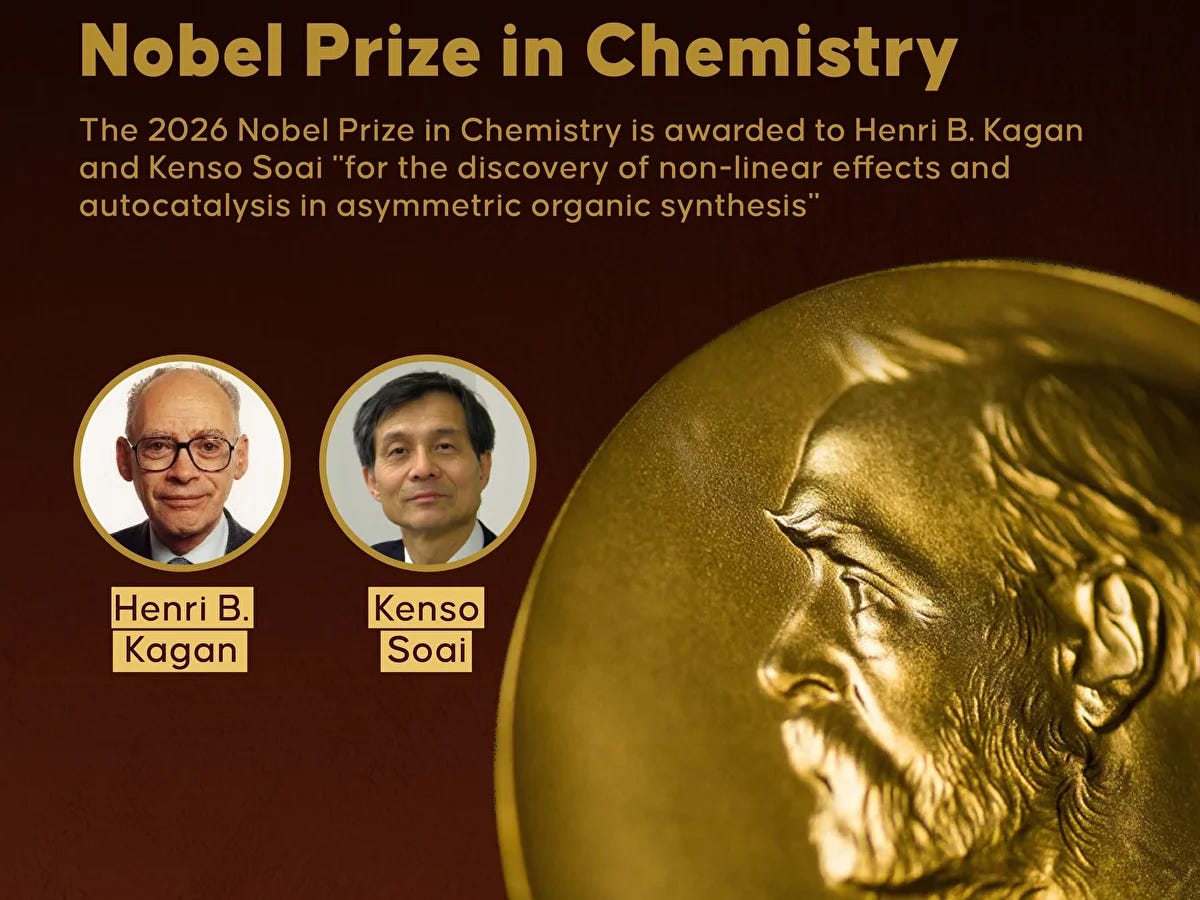
The Royal Swedish Academy of Sciences announced on Wednesday that the 2026 Nobel Prize in Chemistry has been jointly awarded to Henri B. Kagan and Kenso Soai for their monumental contributions to organic chemistry through the development of “spectacular chemical reactions.”
The two scientists were recognized for their independent, groundbreaking discoveries in the field of asymmetric catalysis—a process that allows chemists to selectively construct specific molecular architectures that are vital for modern medicine, agriculture, and materials science.
Many chemical molecules exist as “enantiomers,” meaning they come in two forms that are non-superimposable mirror images of each other, much like a person’s left and right hands. In pharmaceuticals, one “hand” of a molecule might cure a disease, while the other might be completely inactive or even cause harmful side effects.
Henri B. Kagan, a French chemist and professor emeritus at the Université Paris-Saclay, was a foundational pioneer in this space. He developed some of the earliest and most influential methods for asymmetric catalysis, creating innovative chemical tools that reliably force a reaction to produce only the desired “handedness” of a target molecule.
Kenso Soai, a Japanese chemist and professor at the Tokyo University of Science, was honored for his discovery of the “Soai reaction.” His spectacular breakthrough demonstrated asymmetric autocatalysis, a rare and fascinating chemical phenomenon where a chiral molecule actually catalyzes its own creation, leading to a rapid amplification of a single specific enantiomer. Soai’s work not only revolutionized chemical synthesis but also offered profound scientific insights into the origins of biological homochirality—the mystery of why life on Earth prefers specific molecular building blocks.
“This year’s laureates have provided chemistry with entirely new ways of constructing molecules,” the Nobel committee stated during the announcement in Stockholm. “Their spectacular reactions have made the production of critical pharmaceuticals more efficient, precise, and infinitely safer.”
Kagan and Soai will share the prestigious award and its accompanying monetary prize of 11 million Swedish kronor (approximately $1.1 million).