

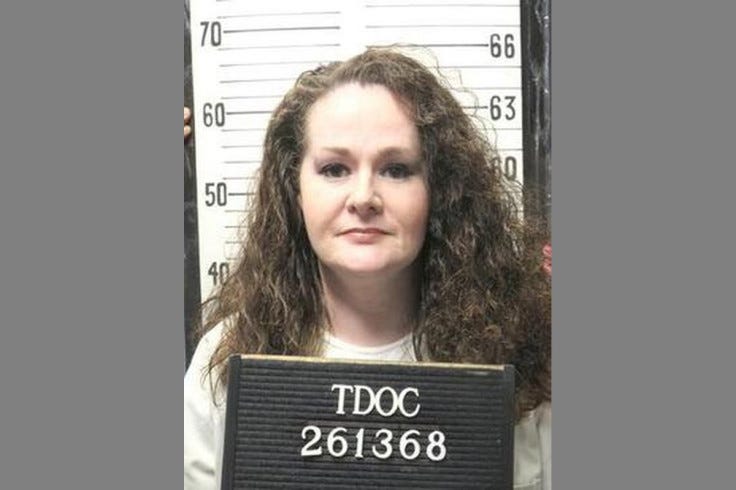
Pike Makes Unexpected Physical Progress
Christa Pike, the Tennessee death-row inmate who survived the state’s failed attempt to execute her, has begun walking with assistance and eating regular meals, according to an update released by her attorneys on Thursday, October 8.
Pike, 50, survived an execution attempt on September 30 after prison officials administered two doses of pentobarbital, the drug used in Tennessee’s lethal-injection protocol. She was rushed to a hospital in Nashville, where she remained unconscious for several days and initially required a ventilator.
Her recovery took an unexpected turn on October 6, when she regained consciousness and began speaking. Her lawyers said she has since shown signs of physical improvement, including increased movement and strength in her arms.
Although the progress has been encouraging, her attorneys caution that significant questions remain about the lasting effects of the failed execution. <Cite refs={[“turn444373view2”,“turn444373view1”]}/>
“Angry and Confused” After Waking Up
Pike’s legal team previously described her as angry and confused after she regained consciousness. According to attorney Randy Spivey, she initially asked questions including, “Where am I?” and “Who are you?”
Her lawyers said she understands, at least to some extent, that Tennessee attempted to execute her. However, they warned that she continues to experience cognitive difficulties and may face a lengthy recovery.
In a statement reported by People, her attorneys said Pike is also dealing with the psychological consequences of believing she was about to die. They described the experience as profoundly traumatic and said it is too early to determine the full extent or duration of its emotional effects.
Her physical improvement does not necessarily mean that the neurological and psychological questions surrounding her condition have been resolved. <Cite refs={[“turn444373view1”,“turn444373view2”]}/>
Serious Injuries Follow the Lethal-Injection Attempt
Pike’s attorneys previously reported pneumonia, a blood clot in one arm and severe swelling in her arms and hands. They have raised concerns that difficulties placing intravenous lines during the execution may have caused the drug to leak into surrounding tissue rather than enter her bloodstream as intended.
The precise medical sequence remains unclear, and Tennessee officials have not publicly provided a definitive explanation for why the execution failed.
The state’s Department of Correction said after the September 30 incident that it had followed the established execution protocol and that Pike had been transported to an outside medical facility.
Her lawyers have questioned that account and sought access to evidence that could establish what happened inside the execution chamber.
The case has prompted renewed scrutiny of lethal-injection procedures, particularly the placement and function of IV lines and the monitoring of inmates during an execution. <Cite refs={[“turn444373view1”,“turn389423search1”]}/>
Judge Orders Tennessee to Preserve Evidence
On October 7, a Davidson County judge ordered state officials to preserve evidence related to the failed execution.
The order is intended to protect material that could help determine how the procedure unfolded. Items identified in court proceedings include execution drugs, syringes, IV lines, recordings, witness accounts, communications and other materials from the death chamber.
Pike’s attorneys argue that preserving the evidence is essential to investigating whether officials followed the state’s procedures and whether her constitutional rights were violated.
State attorneys had argued that a separate court order was unnecessary because evidence was already being collected and documented. The judge nevertheless directed officials to preserve relevant material.
The legal proceedings could become important in determining the circumstances of the failed execution and whether further action by the state would be lawful. <Cite refs={[“turn444373view1”,“turn389423news16”]}/>
Tennessee Pauses Further Executions
Republican Gov. Bill Lee has ordered an independent review of the incident, and Tennessee has paused the state’s remaining executions scheduled for 2026.
The state’s prison chief also resigned following the failed attempt, adding to questions about the administration and oversight of the execution process.
Pike’s death sentence remains in effect. It is not yet clear whether Tennessee will seek to execute her again, and her medical condition could have significant implications for any future legal proceedings.
Her attorneys are asking Lee to commute her sentence to life imprisonment without the possibility of parole. That request would eliminate the death penalty in her case, but the governor has not announced a decision.
The immediate priority, according to her legal team, is her recovery and a full accounting of what happened during the September 30 procedure. <Cite refs={[“turn444373view2”,“turn444373view1”]}/>
The 1995 Murder Case Behind Pike’s Death Sentence
Pike was sentenced to death for her role in the 1995 torture and killing of Colleen Slemmer, a 19-year-old classmate in Knoxville, Tennessee. Pike was 18 at the time of the crime.
Her conviction followed a case involving the beating and stabbing of Slemmer. Pike’s defense attorneys have argued in clemency proceedings that her history of childhood trauma and other personal circumstances were not adequately considered when her sentence was imposed.
Slemmer’s family, meanwhile, has continued to support the death sentence. Her mother, May Martinez, has publicly rejected claims that Pike has shown remorse, saying Pike never apologized for her daughter’s murder.
The victim’s family’s perspective remains central to the case, even as the failed execution raises separate questions about the state’s procedures and Pike’s medical condition. <Cite refs={[“turn444373view1”,“turn444373view2”]}/>
A Recovery With No Clear Long-Term Prognosis
Pike’s ability to speak, eat and walk with assistance marks a significant change from the days when she was unconscious and critically ill. But her attorneys say that physical recovery is only one part of a much larger medical and legal uncertainty.
The state’s investigation and the court-ordered preservation of evidence may help establish why the execution failed. Meanwhile, questions remain about the extent of Pike’s injuries, the effects of the experience on her mental health and whether Tennessee will attempt to carry out the death sentence again.
For now, Pike remains hospitalized as her recovery continues. Her lawyers are seeking clemency while pressing for transparency about the execution attempt.
The case has become a major test of Tennessee’s lethal-injection procedures, with the final outcome still uncertain for both Pike and the state.