

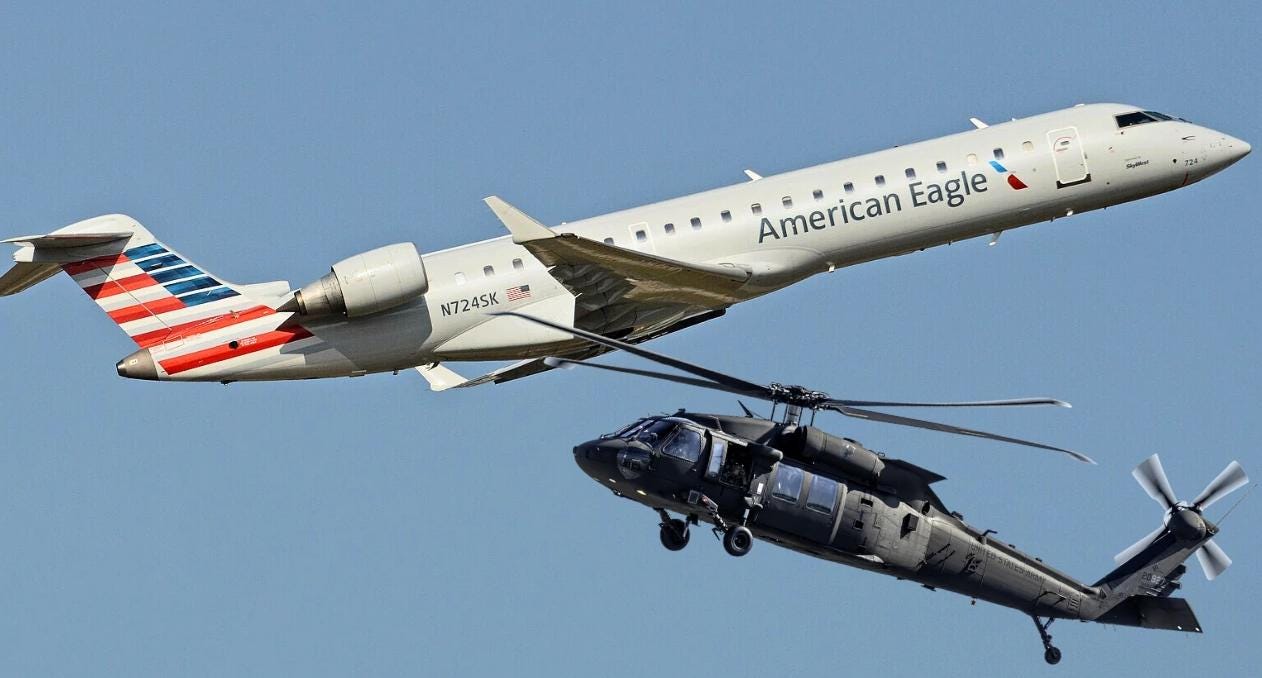
Congressional lawmakers have reached a bipartisan agreement requiring civilian aircraft to carrytechnologythat allows pilots to identify and track nearby planes, marking a significant developmentin effortsto improve aviation safety following the deadly 2025 collision near Washington, D.C.
Senators Ted Cruz, a Republican from Texas, and Maria Cantwell, a Democrat from Washington,announcedthe agreement on November 17, 2026, following months of negotiations over proposedaviationsafety reforms.
The agreement comes nearly two years after an American Airlines passenger jet collided with a U.S.ArmyBlack Hawk helicopter near Ronald Reagan Washington National Airport on January 29, 2025.
All 67 people aboard the two aircraft died in the disaster, making it the deadliest U.S. aviationaccidentsince 2001.
The new agreement would require civilian aircraft to carry Automatic Dependent Surveillance-BroadcastIn(ADS-B In) technology, allowing pilots to receive information about nearby aircraft and improvetheirability to avoid potential collisions.
However, lawmakers still need to resolve disagreements over whether similar requirements shouldapplyto military aircraft operating in shared civilian airspace.
New Aircraft Tracking Technology Could Improve Flight Safety
At the center of the proposed legislation is ADS-B In, a technology designed to provide pilots withreal-time information about nearby aircraft.
The system works alongside ADS-B Out, which broadcasts an aircraft’s location, altitude, speed,andidentification information to other aircraft and ground-based air traffic control systems.
While many aircraft already transmit their positions through ADS-B Out, the complementary ADS-B In system allows pilots to receive and display information about surrounding traffic in the cockpit.
The distinction is important because pilots cannot reliably avoid aircraft they cannot detect.
Under the proposed requirements, civilian aircraft would have to carry equipment that providesgreaterawareness of nearby traffic, potentially reducing the risk of dangerous encounters incrowded airspace.
Aviation safety advocates have argued for years that broader adoption of ADS-B In could helppreventcollisions, particularly in areas where commercial airplanes and military helicopters operatenearone another.
The National Transportation Safety Board (NTSB) has repeatedly recommended expanding theuseof collision-prevention technology.
The latest congressional agreement represents an effort to turn those recommendations intoenforceablesafety requirements.

AP News
+2
Deadly 2025 Collision Exposed Gaps in Aviation Safety
The legislative agreement follows the January 29, 2025, collision between American Airlines Flight5342and an Army Black Hawk helicopter near Reagan National Airport.
The passenger aircraft was traveling from Wichita, Kansas, to Washington, D.C., when it collidedwiththe military helicopter over the Potomac River.
The crash killed all 64 people aboard the passenger plane and all three Army crew membersaboardthe helicopter.
Investigators identified several safety failures that contributed to the disaster, including problemsinvolvingaircraft visibility, altitude awareness, and coordination between civilian and militaryaviation operations.
One particularly significant issue was that the Army helicopter was not broadcasting its positionthroughADS-B Out during the flight.
The helicopter’s location-transmitting equipment had been switched off because of security concerns,eventhough the mission was a training flight.
The passenger aircraft also lacked the complementary ADS-B In technology that could have provideditspilots with additional information about nearby traffic.
The NTSB concluded that better access to aircraft location information could have helpedpreventthe collision.
The tragedy intensified calls for Congress and federal aviation regulators to addresslongstandingweaknesses in the nation’s air traffic safety system.
AP News
+2
Military Aircraft Requirements Remain a Major Disagreement
Although lawmakers have reached an agreement covering civilian aircraft, negotiations overmilitaryrequirements remain a significant obstacle.
Senator Maria Cantwell has argued that military aircraft operating in shared civilian airspace shouldfollowcomparable safety standards.
Her position reflects concerns that military aircraft should not be exempt from basic collision-preventionrequirements when flying near commercial passenger planes.
However, the Pentagon has raised national security concerns about requiring military aircraft tobroadcasttheir locations during certain operations.
Military officials argue that revealing aircraft positions could expose sensitive missions andcreatesecurity risks.
The compromise under discussion would need to balance those concerns with the responsibilitytoprotect civilian passengers and other aircraft.
Senator Ted Cruz has expressed optimism that lawmakers can resolve the remaining disagreementsandpass a final aviation safety package before the end of 2026.
The military provisions remain an important part of the negotiations, and the civilian aircraftagreementshould not be confused with a completed law covering every aircraft category.

The Washington Post
+2
Families of Crash Victims Continue Pressing for Reform
Families of the 67 people killed in the collision have played an important role in pushing Congresstoadvance aviation safety legislation.
Representatives of the victims’ families joined lawmakers at the Capitol during the November17announcement, emphasizing that the proposed changes are about preventing another tragedy.
Their advocacy has focused on ensuring that civilian and military aircraft can identify one anotherwhensharing crowded airspace.
The families have also called for Congress to address the recommendations made by theNationalTransportation Safety Board.
The NTSB issued approximately 50 recommendations related to the disaster, covering aircraft tracking,airtraffic control procedures, military flight operations, and other safety improvements.
Jennifer Homendy, chair of the NTSB, has emphasized the importance of implementing meaningfulsafetyreforms rather than relying solely on voluntary changes.
Capt. Jason Ambrosi, president of the Air Line Pilots Association, has also supported requiringaircraftoperating in shared airspace to be visible to one another.
The aviation community has increasingly argued that technology capable of identifying nearbyaircraftshould become a standard safety feature rather than an optional addition.
AP News
+2
FAA Has Already Introduced Additional Safety Measures
While Congress works toward a broader legislative agreement, the Federal Aviation Administrationhasintroduced several measures intended to reduce collision risks around Reagan National Airport.
The changes include restrictions on how air traffic controllers manage aircraft operating near one another.
Controllers are no longer permitted to rely solely on pilots to visually identify and avoid nearby aircraftincertain situations.
The FAA has also reviewed helicopter routes and operational procedures around the airport toreducethe risk of dangerous encounters between military and civilian traffic.
However, aviation safety advocates argue that operational changes alone are not enough.
They believe the widespread adoption of aircraft tracking and collision-warning technology is necessarytoaddress the underlying problems exposed by the 2025 disaster.
The latest congressional agreement is intended to establish more consistent safety requirementsacrossthe civilian aviation industry.
What Happens Next?
The agreement announced by Cruz and Cantwell represents meaningful progress, but Congressstillhas work to do before the legislation can become law.
House and Senate negotiators must finalize the remaining provisions, particularly those addressingmilitaryaircraft and national security exemptions.
Both chambers previously approved competing aviation safety proposals, creating the need foracompromise that can secure sufficient support in Congress.
Cruz has indicated that he hopes lawmakers can complete the legislation before the end of the year.
If passed, the measure could represent one of the most significant aviation safety reforms sincethe2025 Washington, D.C., collision.
For families of the victims, the legislation represents an opportunity to turn a devastating tragedyintolasting improvements that could protect future passengers and flight crews.
For the aviation industry, it could mean additional equipment requirements, updated safety procedures,andgreater accountability for aircraft operating in crowded airspace.
The central issue remains straightforward: pilots need reliable information about nearby aircrafttoprevent collisions.
Whether Congress can reach a final agreement on military participation will determine howcomprehensivethe reforms ultimately become.