

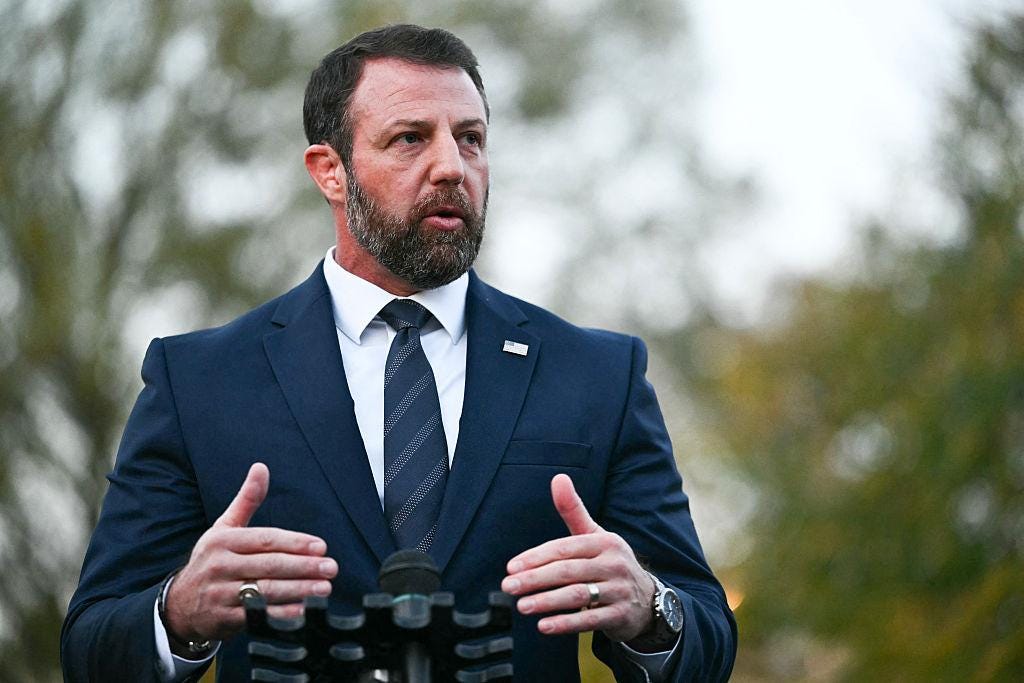
Homeland Security Secretary Markwayne Mullin is facing questions over his decision to travel aboard a government aircraft to attend the LSU-Texas college football game in Louisiana, just one day after a nationwide Federal Aviation Administration (FAA) ground stop caused widespread flight disruptions and left thousands of travelers stranded.
According to reporting first published by the New York Post, Mullin flew to Baton Rouge on Saturday, November 14, to watch the matchup at LSU’s Tiger Stadium. The trip came less than 24 hours after federal officials had helped brief the public on a major aviation disruption that forced flights across the country to remain grounded for more than four hours.
The FAA’s nationwide ground stop, which ended Friday evening, triggered thousands of cancellations and delays. The disruption continued into the weekend, leaving passengers facing lengthy airport lines, missed connections and difficulties securing replacement flights.
Mullin’s attendance at the game quickly attracted attention because of his prominent role in the administration’s response to the aviation crisis.
Mullin defends government aircraft use
Speaking to CNBC on Tuesday, November 17, Mullin defended his decision to attend the game, emphasizing that the trip took place only after U.S. airspace had reopened.
“We would have never went if the airways weren’t completely open,” Mullin said, explaining that airspace had been fully operational for approximately 21 hours before his flight.
He also argued that government aircraft use was a requirement of his position as Homeland Security secretary.
A DHS spokesperson explained that Mullin is required to travel aboard government aircraft to maintain access to secure communications and fulfill continuity-of-government responsibilities in the event of a national emergency.
The department also maintained that Mullin personally reimburses the government for travel unrelated to his official duties.
According to Mullin, he paid for both the flight and his tickets to the football game, insisting that he complied with applicable federal ethics requirements.
Connection to major DHS contractor draws attention
Another aspect of the trip has attracted scrutiny because of the people Mullin was reportedly seen with at Tiger Stadium.
The secretary attended the game in a private suite belonging to Ben Bordelon, president and CEO of Bollinger Shipyards, a Louisiana-based company with longstanding federal government contracts.
Bollinger has received billions of dollars in government business, including a reported $2.2 billion Department of Homeland Security contract to construct six icebreakers.
Mullin said he had never met Bordelon before the game. According to sources cited in media reports, the secretary obtained his tickets through a close friend, House Majority Leader Steve Scalise (R-La.), and paid fair market value.
There has been no public evidence establishing that the football outing involved any improper arrangement or preferential treatment involving the contractor.
Nevertheless, the circumstances have raised questions about the optics of a senior Cabinet official attending a sporting event in a contractor’s private suite while his department oversees significant federal procurement operations.
A weekend of football amid nationwide travel chaos
Mullin’s trip to Louisiana was part of a busy weekend that included another football event in Washington, D.C.
Earlier on Saturday, he attended the annual Secretary’s Cup matchup between the U.S. Coast Guard Academy and the U.S. Merchant Marine Academy at Audi Field before traveling to Baton Rouge.
The LSU-Texas game drew more than 102,000 spectators to Tiger Stadium. Texas ultimately defeated LSU 22-21 after overcoming an 11-point second-half deficit.
Meanwhile, airports across the country were still dealing with the consequences of Friday’s aviation shutdown. Reports described passengers sleeping in terminals, waiting in long lines and struggling to arrange alternative travel.
CNN reported that approximately 1.5 million Americans were dealing with the fallout from the disruption, including canceled flights, missed connections and rebooking difficulties.
KVIA+1
What caused the FAA ground stop?
The nationwide disruption was attributed to a technical failure involving the FAA’s aging telecommunications infrastructure.
Mullin and Transportation Secretary Sean Duffy previously explained that efforts to install new equipment and technology had overwhelmed parts of the older system.
Officials said there was no indication that a cyberattack caused the incident.
The ground stop lasted more than four hours, making it the longest nationwide flight stoppage in approximately 25 years. Although operations resumed Friday evening, the resulting cancellations and delays continued affecting travelers throughout the weekend.
WIRED+1
President Donald Trump subsequently criticized the condition of the country’s aging air traffic control infrastructure and called for additional funding to modernize the system. He also criticized the previous administration over the state of the technology.
Mullin, meanwhile, suggested that the equipment failure was unlikely to result in personnel being fired, emphasizing that the problem involved outdated technology.
Political and ethical questions remain
The controversy places Mullin in an uncomfortable position as the administration faces pressure to modernize the nation’s aviation infrastructure and restore public confidence in federal transportation systems.
The secretary maintains that his travel complied with government rules, that he personally covered the costs and that the flight occurred only after airspace had returned to normal operations.
However, the timing of the trip, the continuing difficulties experienced by passengers and his presence in a private suite associated with a major federal contractor have generated additional scrutiny.
For Mullin, the central issue may ultimately be less about whether the flight was technically permitted and more about the public perception of a senior government official attending a football game while millions of Americans were still dealing with the consequences of a nationwide aviation disruption.
The controversy is likely to keep attention focused on government aircraft policies, federal ethics requirements and the administration’s handling of the FAA’s infrastructure problems.