

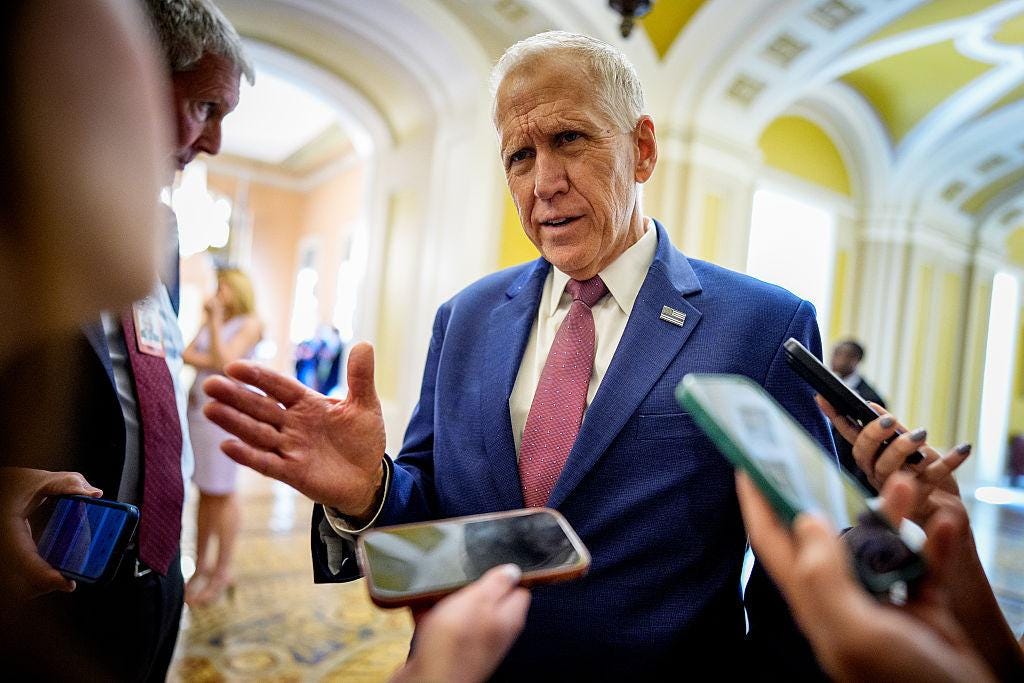
A prominent Republican senator is challenging President Donald Trump’s decision to allow Russian diesel fuel into global markets, warning that the move may violate federal law and provide financial support to Russian President Vladimir Putin as the war in Ukraine continues.
Sen. Thom Tillis of North Carolina said Sunday that there was a “legitimate case” for arguing that Trump was not following the law. His criticism came after the administration temporarily eased sanctions affecting Russian diesel transactions and announced an arrangement under which Moscow would supply fuel to international markets.
The dispute has drawn criticism from Republicans and Democrats alike, placing the administration’s energy policy under scrutiny just weeks before the November midterm elections. Treasury Secretary Scott Bessent has defended the move, saying the administration will use its existing legal authority to implement the arrangement.
Tillis Questions the Legality of the Deal
Speaking on NBC’s Meet the Press on October 11, Tillis said Trump’s decision could run afoul of federal law.
“I do believe there’s a legitimate case for saying the president’s not following the law,” Tillis said.
The retiring senator also warned that the policy could put American lives at risk and suggested that congressional Republicans could use funding negotiations to press the administration to reconsider.
Tillis’s criticism is significant because it comes from within Trump’s own party. Rather than simply objecting to the administration’s policy on strategic grounds, the senator has questioned whether the president’s actions comply with legal restrictions on Russian energy imports.
His comments do not constitute a legal ruling, and the administration disputes the contention that its actions are unlawful.
Trump Announces Russian Diesel Supply Arrangement
Trump announced the arrangement on October 9, saying Russia had agreed to supply diesel fuel to international markets.
According to his announcement, the proposed deliveries included an initial 300,000 tons of diesel, followed by an additional 1 million tons in November and another 3 million tons within a relatively short period. The Kremlin subsequently confirmed Russia’s readiness to supply oil and petroleum products to U.S. and global markets, although the full terms of the arrangement were not immediately clear.
The administration’s move included a temporary easing of restrictions through the Treasury Department’s Office of Foreign Assets Control. On October 9, OFAC issued Russia-related General License 135, authorizing specified transactions connected with the sale, delivery, offloading and importation of Russian-origin diesel fuel.
The administration has presented the arrangement as a way to increase fuel availability and ease pressure on prices. Critics question whether additional Russian supply would produce sustained savings for American consumers.
A Clash With the 2022 Russian Energy Import Ban
The dispute centers in part on legislation enacted after Russia launched its full-scale invasion of Ukraine in February 2022.
The Ending Importation of Russian Oil Act, signed into law in April 2022, prohibited imports of specified Russian energy products. The law also established a process for terminating that prohibition, including presidential certification to Congress and a 90-day period before termination could take effect, subject to congressional disapproval.
Critics argue that the administration’s decision to authorize Russian diesel transactions conflicts with the law’s restrictions and that Congress should have been consulted.
The administration, meanwhile, says it can proceed using existing legal authorities and the new Treasury license. The precise legal question is whether the administration’s temporary authorization fits within applicable statutory and sanctions authorities. That question should not be treated as settled simply because lawmakers have challenged the policy.
Bipartisan Pushback Against the White House
Tillis is not the only Republican criticizing the decision. Republican senators Susan Collins of Maine, Lisa Murkowski of Alaska and John Curtis of Utah joined Tillis and Democratic senators Jeanne Shaheen of New Hampshire, Richard Blumenthal of Connecticut and Ron Wyden of Oregon in calling on Trump to reverse course.
The seven senators argued that the United States should not provide Russia with additional revenue while Russian forces continue attacking Ukraine. They also said the administration had failed to consult Congress or provide the explanation they believe the law requires.
Former Vice President Mike Pence also criticized the move, calling it a betrayal of the sanctions policy associated with the late Sen. Lindsey Graham. Republican Rep. Don Bacon of Nebraska separately objected to a policy he said could support Russia’s war economy.
Not all Republicans agree with the criticism. Senate Republican Whip John Barrasso of Wyoming defended Trump’s decision, arguing that the president was trying to reduce costs for consumers, farmers, ranchers and truckers.
The divisions demonstrate that the dispute is not simply a partisan confrontation between Republicans and Democrats. It also reflects disagreements among Republicans about the balance between reducing energy costs and maintaining economic pressure on Moscow.
Treasury Secretary Defends the Administration’s Authority
Treasury Secretary Scott Bessent defended the arrangement during an appearance on Fox News, saying the administration would proceed using the legal powers available to it.
“We’re going to do it with all the legal authorities we have,” Bessent said, rejecting claims that existing or recently enacted sanctions legislation necessarily prohibits the policy.
The administration argues that allowing additional diesel supply into international markets could help ease high fuel prices. Diesel is widely used in trucking, agriculture, industrial operations and home heating, making its price important to businesses and households.
However, analysts cited in reporting on the agreement have questioned whether the arrangement will produce sustained price reductions. The effect will depend on the amount of fuel actually delivered, market conditions and the broader international supply picture.
Ukraine and European Allies Raise Concerns
The agreement has also drawn objections from U.S. partners concerned about the revenue Russia receives from energy exports.
Canadian Prime Minister Mark Carney raised the issue in a call with Ukrainian President Volodymyr Zelensky, with Carney’s office saying the diesel arrangement ran counter to efforts by Ukraine, Canada and their allies to promote peace and stability in Europe.
The controversy comes amid continued debate over how Washington should pressure Moscow to end the war. Supporters of sanctions argue that restricting Russian energy revenue reduces the resources available to fund military operations. Those favoring the administration’s approach contend that flexibility in energy policy may help address immediate market pressures.
The central policy question is whether the potential benefits to fuel supply and prices justify relaxing restrictions that were designed to impose economic costs on Russia.
Midterm Politics Add to the Pressure
The dispute comes less than a month before the November 3 midterm elections, when Republicans will seek to retain control of Congress.
Fuel prices are politically sensitive because diesel costs affect freight transportation, food distribution, farming and other sectors of the economy. The administration’s promise of lower energy costs therefore carries both economic and political implications.
At the same time, criticism from Republican lawmakers could complicate the White House’s efforts to present a unified position on Russia and Ukraine.
For now, the administration maintains that its legal authority permits the arrangement, while Tillis and other senators are demanding that Trump reverse course. Whether the policy survives legal and congressional scrutiny—and whether it delivers meaningful savings at the pump—remains unresolved.