

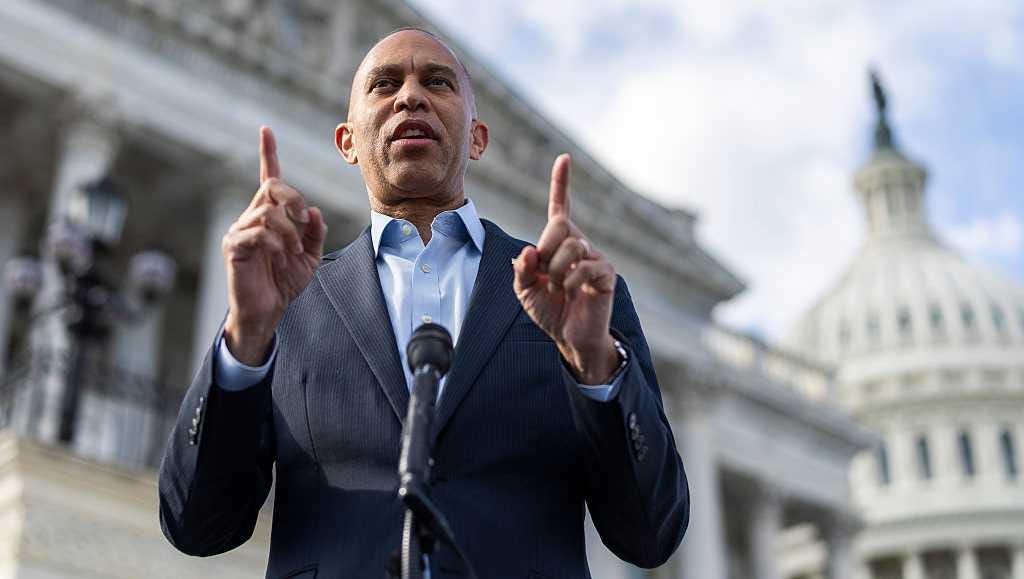
Democrats give Jeffries an overwhelming endorsement
Rep. Hakeem Jeffries of New York has secured the Democratic Party’s formal nomination for speaker of the U.S. House of Representatives, putting him on course to make history as the first Black American to hold the powerful congressional position.
In a closed-door Democratic caucus meeting on Wednesday, November 18, Jeffries won the nomination by a vote of 251 to 11. The result demonstrated broad support among incoming Democratic lawmakers, despite criticism from some progressive members who had questioned whether his leadership would deliver the policy changes they want.
No Democrat formally challenged Jeffries for the nomination.
The nomination follows Democrats’ victories in the November 3 midterm elections, which returned the party to control of the House. With Democrats expected to hold a substantial majority, Jeffries is widely expected to secure the 218 votes needed when the full House elects its speaker on January 3, 2027.
A historic milestone in congressional leadership
If elected by the full House, Jeffries would become the first Black speaker in American history.
The position is one of the most influential offices in Washington. The speaker presides over the House, helps determine the chamber’s legislative agenda and plays a central role in negotiations over federal spending, government oversight and national policy. The speaker also stands second in the presidential line of succession, after the vice president.
Jeffries, 56, has represented New York’s 8th Congressional District since 2013 and has led House Democrats as minority leader since 2023. He succeeded Nancy Pelosi as the party’s leader after Democrats lost their House majority in the 2022 midterms.
His expected elevation would mark a major transition for the party, bringing a new generation of Democratic leadership into control of the chamber.
Progressive Democrats raise concerns
Despite his decisive victory, Jeffries faces pressure from the party’s progressive wing.
Some newly elected Democrats have argued that the party needs a more aggressive legislative agenda, particularly on healthcare, campaign finance reform, immigration enforcement and U.S. policy toward Israel.
Several incoming lawmakers withheld their support or voted against Jeffries, seeking stronger commitments on issues they emphasized during their campaigns.
Rep.-elect Don Leonard of Ohio, for example, said he would not support Jeffries without commitments involving U.S. military assistance to Israel and campaign finance reform. Other progressive members have pushed for policies such as Medicare for All and stronger restrictions on Immigration and Customs Enforcement.
Seven incoming progressive lawmakers also issued a statement saying that, although discussions with Jeffries had produced some progress, more work remained to ensure the party’s direction reflected voters’ expectations.
Jeffries has attempted to address some of these concerns while maintaining support from moderate Democrats. He has recently called for changes in U.S. policy toward Israel and proposed expanding Medicare coverage, including vision and dental benefits.
The leadership challenge ahead will be balancing these competing priorities while keeping a large and ideologically diverse Democratic majority united.
New Democratic leadership team takes shape
The caucus vote also signals a broader leadership transition within the party.
Rep. Katherine Clark of Massachusetts is positioned to become the first woman to serve as House majority leader. Rep. Pete Aguilar of California is expected to become majority whip, while Rep. Ted Lieu of California was elected Democratic caucus chair.
Together, the leadership team represents a generational shift in the party’s congressional leadership.
The new leadership will be responsible for coordinating legislation, managing internal disagreements and advancing Democratic priorities once the party assumes control of the House.
Jeffries prepares for confrontation with Trump
Jeffries’ expected speakership will place him at the center of the political confrontation with President Donald Trump during the final two years of Trump’s current term.
Democrats have signaled plans to pursue an ambitious agenda focused on affordability, healthcare and government accountability. They are also expected to intensify congressional oversight of the Trump administration through hearings, investigations and demands for information.
Jeffries has emphasized lowering the cost of living and restoring what he describes as accountability in government. He has also promised to pursue what he calls transformational change in response to voters’ concerns.
However, governing with a large majority will not necessarily be easy. Democrats will have to reconcile progressive demands for sweeping policy changes with the concerns of more moderate lawmakers elected in competitive districts.
The party’s ability to maintain unity could determine how effectively it uses its newly regained control of the House.
January 3 will be the decisive vote
Wednesday’s nomination was an internal Democratic decision, not the final election for speaker. The full House must formally elect its leader when the new Congress convenes on January 3, 2027.
Given the size of the incoming Democratic majority and Jeffries’ overwhelming caucus support, his path to the speakership appears strong.
If elected, Jeffries will make history while assuming responsibility for one of the most consequential roles in American government. His leadership will be tested immediately as Democrats prepare to challenge Trump’s agenda, pursue investigations and demonstrate that they can govern effectively.