

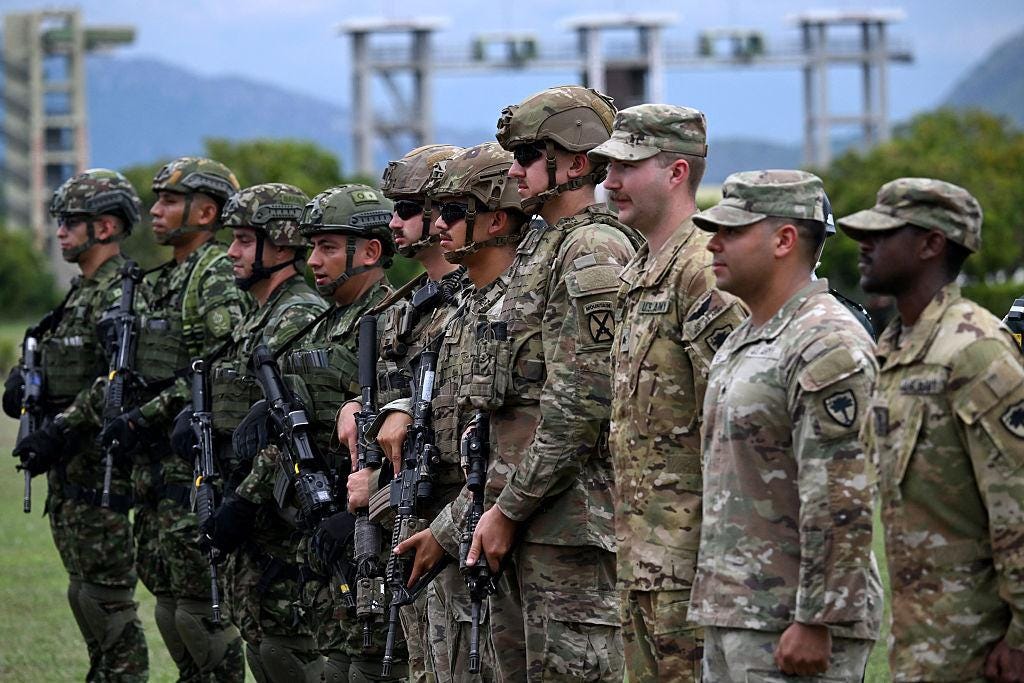
U.S. Defense Secretary Pete Hegseth is traveling to Colombia on Wednesday, November 18, for high-level discussions on regional security, military cooperation and the fight against drug trafficking and illegal armed organizations.
The visit comes as the Trump administration seeks to strengthen its security partnerships across Latin America and expand cooperation with governments confronting powerful drug cartels and armed groups.
Colombian Defense Minister Jorge Eduardo Mora announced Hegseth’s visit before the country’s Congress on Tuesday, confirming that the American defense chief would meet with Colombian officials in Bogotá.
One of the most significant developments will be the delivery of the first U.S. Hercules C-130 military transport aircraft to Colombia’s armed forces. Mora indicated that two additional aircraft could follow.
“We’re going to look at other interesting issues, such as how the U.S. needs to continue supporting us to restore security for Colombians,” Mora told lawmakers.
The aircraft delivery represents a tangible expansion of the countries’ longstanding defense relationship, providing Colombia with additional military transportation capabilities that can support operations across its challenging geography.
Trump Administration Expands Security Cooperation in Latin America
Colombia remains one of Washington’s most important security partners in the Western Hemisphere.
For decades, the two countries have cooperated on counter-narcotics operations, intelligence sharing, military training and efforts to combat illegal armed organizations.
Colombia continues to face threats from drug-trafficking networks and armed groups operating across remote rural areas, border regions and strategic transportation corridors.
The country’s decades-long internal conflict has killed approximately 450,000 people and displaced millions, making security cooperation a central issue for successive Colombian governments.
In August 2026, Colombia joined the U.S.-led Shield of the Americas initiative, a multinational effort designed to coordinate regional action against drug cartels and other transnational criminal organizations.
The initiative reflects President Donald Trump’s broader strategy of treating organized criminal networks as major security threats requiring stronger military and intelligence cooperation.
C-130 Aircraft Delivery Strengthens Colombian Military Capabilities
The delivery of the Hercules C-130 is a central component of Hegseth’s visit.
Manufactured by Lockheed Martin, the C-130 is a versatile military transport aircraft used by armed forces worldwide to move personnel, equipment and supplies.
Its ability to operate from relatively short and less-developed runways makes it particularly valuable in countries such as Colombia, where mountainous terrain, dense forests and remote communities complicate military logistics.
Additional aircraft could improve Colombia’s ability to move troops and equipment, support counter-narcotics missions and respond to security emergencies in difficult-to-reach areas.
The delivery also signals continued American commitment to Colombia’s defense capabilities at a time when regional security challenges are becoming increasingly complex.
Hegseth Signals a More Aggressive Approach Against Cartels
The visit follows Hegseth’s appearance at U.S. Southern Command headquarters in Miami, which oversees American military operations throughout Latin America and the Caribbean.
In a video released by the Pentagon, Hegseth emphasized a more forceful military approach toward designated terrorist organizations operating throughout the region.
“The idea here is to be kinetic, to kill the enemy,” Hegseth said, referring to organizations he accused of ravaging communities across the Americas.
His remarks reinforce the Trump administration’s willingness to consider stronger military measures against transnational criminal networks.
In August, Hegseth also discussed the possibility of joint military strikes against Colombian armed groups, including the National Liberation Army (ELN) and remnants of the Revolutionary Armed Forces of Colombia (FARC).
Those comments highlighted the potential for a deeper military partnership between Washington and Bogotá, although the precise scope of any future joint operations remains a matter for the two governments.
Colombia Becomes a Key Partner in the Shield of the Americas
Colombia’s participation in the Shield of the Americas initiative gives the country an important role in Washington’s regional security strategy.
The initiative seeks to strengthen coordination among participating governments against drug cartels, trafficking organizations and other transnational criminal groups.
Expanded intelligence sharing, military assistance and operational coordination could become important elements of the partnership.
For Washington, Colombia’s geographic position is particularly significant. The country borders Venezuela, Ecuador, Peru, Brazil and Panama, while maintaining access to both the Caribbean Sea and Pacific Ocean.
These characteristics make Colombia strategically important in efforts to disrupt international drug-trafficking routes and strengthen security throughout the hemisphere.
Venezuela Reports Remain Unconfirmed
Hegseth’s regional trip has also generated speculation about a possible visit to Venezuela following his stop in Colombia.
Regional media outlets have reported that Venezuela could be included in his itinerary. However, Reuters reported that it could not independently confirm those accounts.
The possibility comes amid heightened American military activity and broader tensions surrounding regional criminal organizations and security operations.
For now, the confirmed focus of Hegseth’s Colombia visit remains military assistance and bilateral security cooperation.
A Stronger U.S. Security Presence in the Western Hemisphere
Hegseth’s visit underscores the Trump administration’s determination to make regional security a central component of American foreign and defense policy.
By delivering military equipment, strengthening intelligence cooperation and working with regional allies, Washington is seeking to build a more coordinated response to drug cartels and armed organizations.
For Colombia, additional American military assistance could improve operational capabilities and support efforts to restore security in areas affected by organized crime and decades of armed conflict.
For the United States, a stronger partnership with Bogotá could help protect American interests, disrupt drug-trafficking networks and reinforce its strategic position in Latin America.
The message from Washington is increasingly clear: the Trump administration wants regional allies to take a more active role in confronting criminal organizations, with American military support remaining an important part of that strategy.