

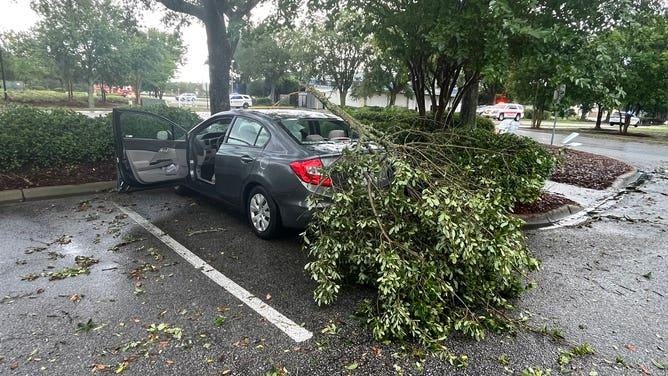
Hurricane Isaias struck Florida’s western Panhandle late Friday, October 9, bringing destructive winds, heavy rainfall and dangerous coastal flooding to communities along the Gulf Coast.
The storm made landfall near Destin at approximately 9:30 p.m. EDT as a Category 2 hurricane, with maximum sustained winds of 105 mph, according to the National Hurricane Center and Florida officials. Its effects extended into southern Alabama, where fallen trees, damaged power lines and flooding disrupted communities.
By early Saturday, Isaias had weakened after moving inland. However, authorities warned that the danger would persist as heavy rain, flooding and the possibility of tornadoes threatened parts of the Southeast.
Powerful Winds Batter Florida’s Gulf Coast
Isaias brought hurricane-force winds to coastal communities around Destin, Pensacola and other parts of the Florida Panhandle.
A weather station near Santa Rosa Sound recorded a gust of 116 mph, while a station near Pensacola recorded a gust of 100 mph, according to reports cited by the New York Post.
The winds toppled trees and power lines, blocked roads and damaged structures. Video from Pensacola showed the roof of an inn being torn away during the storm.
The full extent of the damage was not immediately clear as the storm moved inland and emergency crews began assessing conditions.
Storm Surge and Flash Flooding Threaten Coastal Communities
The hurricane also brought dangerous water levels and flooding to low-lying coastal areas.
Before landfall, forecasters warned that some areas could experience storm surge of 6 to 9 feet above ground level. After the storm came ashore, Florida officials reported that water levels in Panama City Beach had risen approximately 5.6 feet above the average high-tide level.
The National Weather Service warned that heavy rainfall could produce widespread flooding, with expected totals of 4 to 8 inches and isolated amounts reaching 15 inches in some locations.
Flooding posed a particular danger where roads were already saturated or covered with water. Officials urged residents to avoid driving through flooded streets and to remain in safe locations until conditions improved.
Hundreds of Thousands of Customers Lose Power
The storm damaged electrical infrastructure across Florida, leaving hundreds of thousands of customer accounts without electricity.
Florida officials reported approximately 448,298 customer accounts without power statewide as of 7 a.m. on Saturday, October 10. More than 16,000 utility workers and restoration personnel had been positioned ahead of the storm, allowing crews to begin repairs when conditions permitted.
The Florida State Guard also deployed nearly 400 personnel to assist with recovery operations, including clearing routes, supporting distribution points and helping with search-and-rescue efforts.
Restoration remained challenging in areas where debris, flooding and hazardous weather made it difficult for workers to reach damaged infrastructure.
Florida and Alabama Officials Warn Residents to Stay Off Roads
Florida Gov. Ron DeSantis urged residents to avoid unnecessary travel while dangerous conditions persisted.
Some counties temporarily suspended emergency response operations during the storm because winds and flooding made it unsafe for personnel to work outdoors.
In Pensacola, police warned residents to stay off roads obstructed by debris. Southern Alabama also reported flooding, fallen trees and damaged power lines.
Officials cautioned that conditions could remain hazardous even after the storm’s center moved away, particularly in locations vulnerable to flash flooding and falling trees.Tornadoes and Heavy Rain Remain a Concern
Although Isaias weakened after landfall, the storm continued to pose risks well beyond the immediate coastline.
The National Weather Service warned of additional damaging wind gusts, heavy rainfall and possible tornadoes across parts of the Florida Panhandle, southern Alabama and southwestern Georgia.
Forecasters also warned that saturated ground could increase the risk of flooding as additional rain moved through the region. The storm’s northward track carried its effects inland, meaning communities far from the Gulf Coast could still face dangerous conditions.
Residents were urged to follow local emergency instructions and monitor official weather alerts as the system weakened.
Trump and DeSantis Address the Storm Response
President Donald Trump commented on the hurricane as it moved across the Gulf Coast. He also canceled a scheduled appearance at a college football game in Alabama amid the storm response.
DeSantis and state officials provided updates from Florida’s State Emergency Operations Center on Saturday, outlining ongoing recovery efforts and the deployment of emergency personnel.
Florida declared a state of emergency covering 27 counties as authorities coordinated response and restoration operations. Recovery Efforts Begin as Isaias Weakens
The immediate focus shifted from preparations for landfall to restoring electricity, clearing debris, assessing structural damage and helping residents affected by flooding.
Although Isaias was no longer classified as a hurricane by early Saturday, its weakening did not eliminate the risks associated with standing water, damaged infrastructure and additional rainfall.
The final toll in property damage and disruption will depend on assessments conducted as conditions improve. For communities across Florida’s Panhandle and southern Alabama, the recovery effort is likely to continue after the storm itself moves farther inland.