

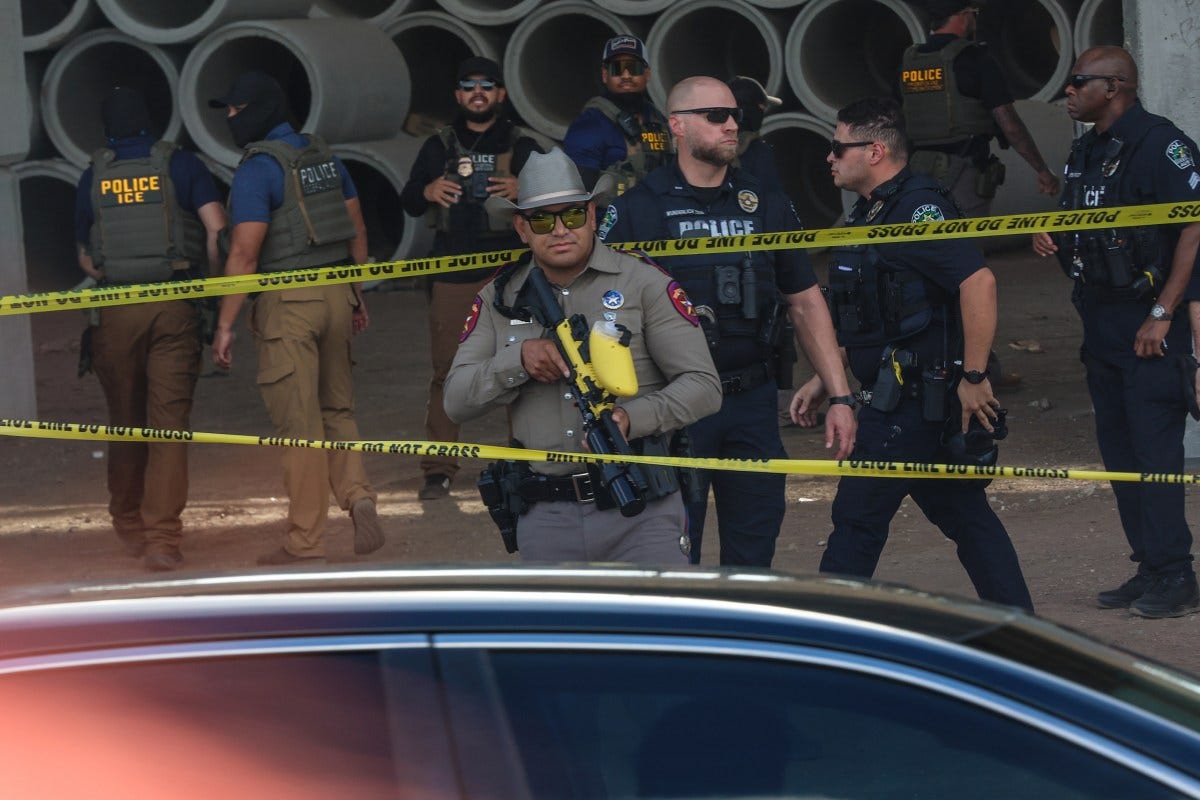
The federal immigration officer who shot a Venezuelan man during a traffic stop in Austin on Sunday was not wearing his assigned body camera, according to multiple news reports.
The unnamed U.S. Immigration and Customs Enforcement (ICE) agent—described as a recent recruit—was issued the recording equipment but did not have it equipped when he fired at 28-year-old Wilber Rafael Garces Perez. The revelation, first reported by The Atlantic, The Washington Post, and NBC News citing unnamed Department of Homeland Security (DHS) officials, adds another layer of controversy to an already heavily scrutinized use of force.
It remains unclear why the ICE officer was not wearing the device during the encounter, which left Garces Perez, who had been working as a DoorDash delivery driver, with a bullet lodged in his back.
Missing Footage
While the primary officer’s perspective was not recorded, another ICE agent involved in the arrest was reportedly wearing a body camera. However, sources told NBC News that the second agent’s footage did not capture the actual shooting.
The Department of Homeland Security has not immediately responded to requests for comment regarding the missing footage or the agency’s body camera protocols.
The lack of video evidence has infuriated advocates and the victim’s legal representation, who are demanding immediate transparency from the federal government.
“You need to answer why your agents are not turning their body cams on,” Kate Lincoln-Goldfinch, the attorney representing Garces Perez, demanded in a social media post directed at DHS Secretary Markwayne Mullin on Tuesday.
A Growing Pattern?
The Austin incident is the latest in a series of controversial encounters involving ICE officers in Texas. It follows a highly publicized shooting in Houston earlier this year where acting ICE Director David Venturella confirmed that the agents involved similarly did not have body-worn or dashboard cameras equipped.
As local authorities, including the Austin Police Department, continue to investigate the circumstances that led to the brief vehicle pursuit and subsequent shooting, the absence of objective video evidence threatens to stall accountability efforts and further erode public trust in federal immigration enforcement operations.