

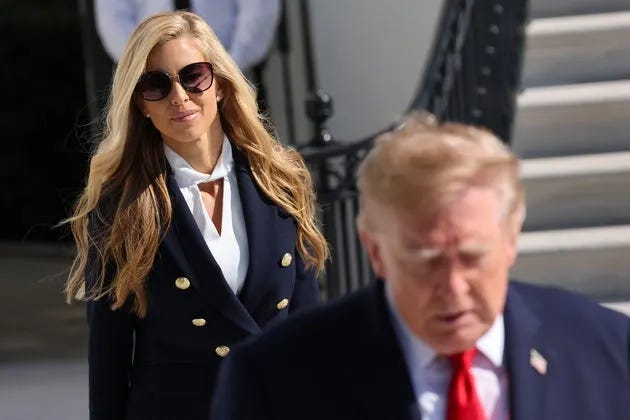
The intense media scrutiny surrounding new White House Press Secretary Katie Zacharia and her legal credentials may be rooted in a fundamental misunderstanding of legal terminology, according to a recent analysis published by National Review.
Zacharia, who recently assumed the role of President Trump’s chief spokesperson, has faced mounting criticism and accusations of lying after referring to herself as a “lawyer.” The controversy escalated when, in response to a shouted question during a briefing, she implied that she had passed the bar exam in China—a claim widely disputed by legal experts, as foreign nationals are generally not permitted to practice law in the country.
The situation culminated this week when a watchdog group, the Campaign for Accountability, formally reported Zacharia to the California Bar Association.
However, writing for National Review, Wesley J. Smith argues that the uproar is largely a “tempest-in-a-teapot moral panic” fueled by the press conflating the terms “lawyer” and “attorney.”
While frequently used interchangeably in casual conversation, the two identifiers carry distinct professional meanings. A “lawyer” is broadly defined as anyone who has completed a legal education and obtained a law degree. An “attorney,” on the other hand, is a specific designation for someone who has passed a state bar examination and is licensed by the requisite authorities to actively represent clients in court.
“In other words, all attorneys are lawyers but not all lawyers are attorneys,” Smith wrote.
Because Zacharia earned a Juris Doctor degree from Pepperdine Law School, Smith asserts that she is “unquestionably and factually a lawyer.” However, since she was reportedly never licensed to practice law in the United States, she is not an attorney.
Smith also questioned the logic behind the Campaign for Accountability’s complaint to the California Bar Association.
“If she is not licensed to practice law in California, the state bar has no jurisdiction over her,” Smith noted. “Moreover, I have not seen any reporting that she ever held herself out as licensed in that state or ‘represented’ any clients there, so I am not sure what egregious wrong she is supposed to have committed that the bar association can remedy. What is it supposed to do, revoke her law degree?”
While acknowledging that Zacharia’s comments regarding the Chinese bar exam created a “bit of a mess,” Smith concluded that her specific legal licensing status is ultimately irrelevant to her current position. Zacharia serves as a communications aide to the president, a role that does not require one to act as legal counsel or maintain an active license to practice law.