

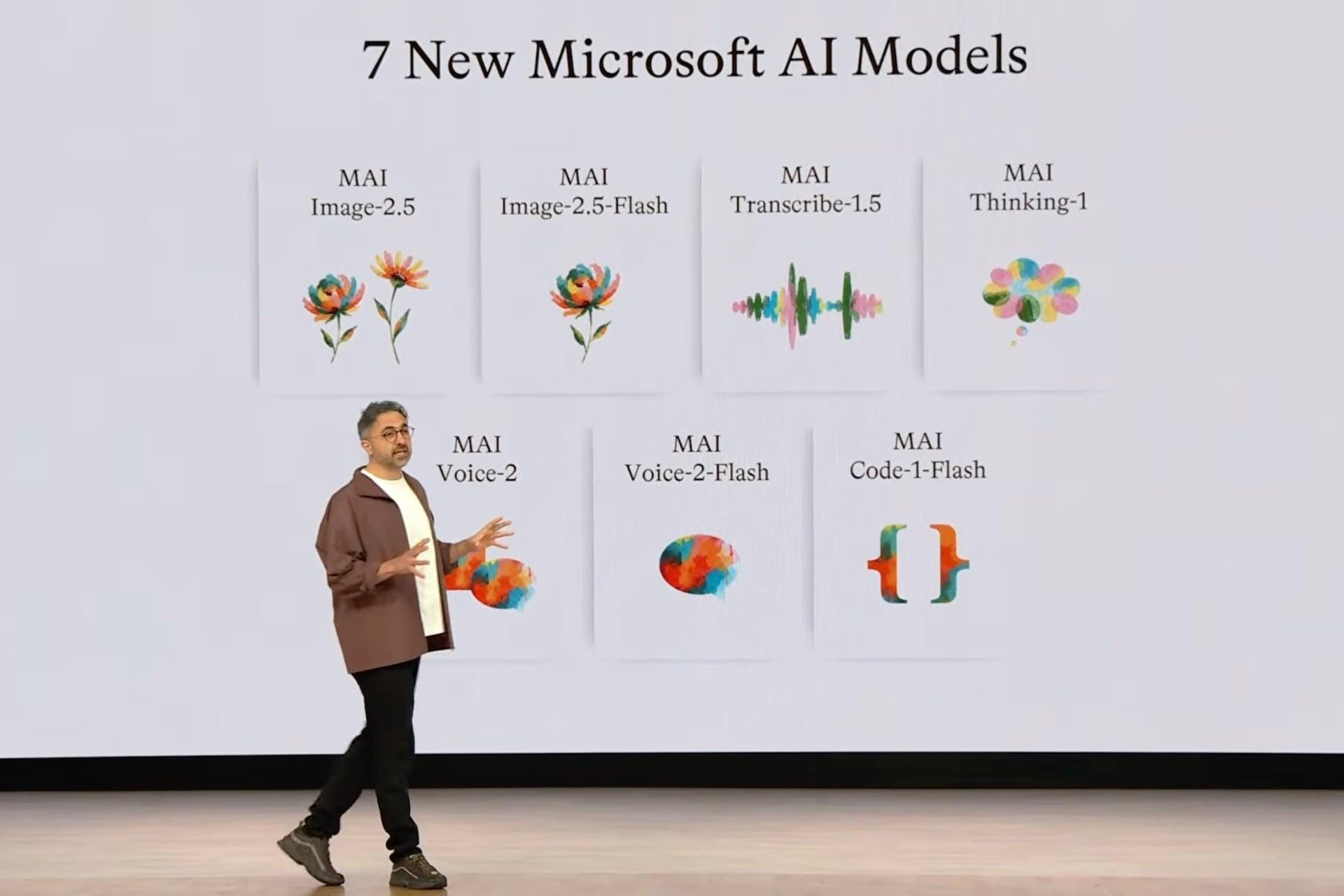
Microsoft is stepping up its competition with OpenAI and Anthropic by introducing a new family ofartificialintelligence models designed to deliver advanced coding, cybersecurity, and other capabilitiesata lower cost.
The announcement was made November 17, 2026, during Microsoft’s Ignite conference in SanFrancisco,where the company introduced seven new AI models aimed at businesses, developers,andenterprise customers.
Among the most significant releases are MAI Code 2, a model focused on software development,andMAI Cyber 2 Flash, designed to help cybersecurity professionals identify software vulnerabilitiesandstrengthen digital defenses.
Microsoft says its strategy is to develop specialized AI models that can deliver competitiveperformancewithout requiring the enormous computing resources and expenses associated withsome largergeneral-purpose systems.
The announcement represents an important shift in Microsoft’s AI ambitions. Although the companyhasinvested heavily in OpenAI and integrated its technology into products such as Copilot, it isincreasinglydeveloping its own models to compete directly with the industry’s biggest AI providers.
The move puts Microsoft in more direct competition with OpenAI’s GPT models and Anthropic’sClaudefamily, particularly in the enterprise software and cybersecurity markets.

Reuters
+2
Microsoft Introduces MAI Code 2 for Software Developers
One of the headline announcements is MAI Code 2, Microsoft’s latest programming-focused AI model.
The system is designed to help developers write code, identify errors, troubleshoot complicatedsoftwareproblems, and make changes across multiple files within large projects.
Microsoft says the model achieves approximately 98% of the coding performance of OpenAI’sGPT-6.1 Sol at around 40% of its price.
The company also claims MAI Code 2 reaches approximately 96% of Anthropic’s Claude Opus5.5performance at just 5% of the cost, based on Microsoft’s selected coding benchmarks.
These comparisons are particularly important for businesses that increasingly rely on AI-powereddevelopment tools to accelerate software production.
Rather than paying premium prices for every programming task, companies could potentially usespecializedmodels to handle everyday coding work more economically.
Microsoft is integrating MAI Code 2 into GitHub Copilot, giving developers access to the technologythroughan established programming platform.
A smaller version, MAI Code 2 Flash, is also being introduced for routine tasks such as codeexplanations,targeted edits, basic fixes, and rapid development iterations.
The company says the smaller model offers an additional cost advantage for organizations handlinglargevolumes of everyday programming requests.

Axios
+2
MAI Cyber 2 Flash Targets Growing Cybersecurity Threats
Another major announcement involves MAI Cyber 2 Flash, Microsoft’s specialized artificial intelligencemodelfor cybersecurity.
The model is designed to help security teams identify software vulnerabilities, investigate potentialthreats,and improve their ability to respond to cyber incidents.
As artificial intelligence becomes more powerful, cybersecurity professionals are facing anincreasinglycomplicated environment. AI tools can help defenders identify weaknesses more quickly,but theycan also give malicious actors new ways to discover and exploit vulnerabilities.
Microsoft believes specialized AI models can help organizations keep pace with these evolving threats.
According to the company’s published benchmark results, MAI Cyber 2 Flash achieved a 92.3% successrateon the CyberGym-E2E security benchmark, compared with 91.5% for OpenAI’s GPT-6 Astra.
Microsoft also claims its model can achieve comparable results at less than 2% of the cost per task.
The company plans to make the cybersecurity model available through selected Microsoft securityproducts,including its vulnerability-scanning and investigation tools.
The initial rollout is intended for a limited group of customers, allowing Microsoft to expand accesswhilecontinuing to evaluate the technology.
The announcement reflects Microsoft’s broader strategy of using AI to strengthen corporatecybersecurityand help organizations respond to threats more efficiently.

Microsoft AI
+2
Microsoft Expands Into Image Generation and Voice Technology
The company’s latest AI announcements extend beyond programming and cybersecurity.
Microsoft also introduced new models for image generation, audio transcription, andreal-timevoice interactions.
One of the releases, MAI Image 2.7, is designed to improve image editing and generation capabilities.
Microsoft says the model performed strongly in independent image-editing evaluations conductedbyArtificial Analysis, although its performance claims are based on specific testing conditions.
The company also introduced MAI Realtime 1, a voice-focused model designed to support morenatural,real-time audio interactions.
Another important release is MAI Transcribe 2, which powers Microsoft’s DragonCopilottranscription capabilities.
Microsoft says the transcription technology is already supporting approximately 10 million patientencountersper month, helping healthcare professionals convert conversations into writtenclinical documentation.
The new models demonstrate Microsoft’s intention to compete across several major AI categoriesratherthan concentrating exclusively on text-based chatbots and programming assistants.

Source
+1
Microsoft Wants Businesses to Have More Control Over AI Models
Beyond developing its own models, Microsoft is also trying to address a major concern amongenterprisecustomers: control over their data and artificial intelligence systems.
The company announced an expanded offering called MAI Licensed Weights, which allows eligibleenterprisecustomers to obtain licensed model weights and customize models using their ownproprietary information.
These customized models can then be deployed within the customer’s Azure environment.
The approach gives businesses greater control over how their AI systems are adapted, accessed,andintegrated into existing operations.
For companies working with sensitive financial information, healthcare records, intellectual property,orconfidential business documents, this flexibility could be particularly valuable.
Microsoft argues that organizations should not have to sacrifice control over their data to benefitfromadvanced AI capabilities.
The company is positioning its licensed model approach as an alternative to relying entirely onexternallyhosted AI services.
However, the offering is not the same as unrestricted open-source software. Customers receivelicensedaccess under Microsoft’s terms, with deployment and security arrangements tied to Azure.
Axios
+1
Microsoft Takes Aim at OpenAI and Anthropic
The latest releases highlight an increasingly competitive relationship between Microsoft and theAIcompanies it has worked closely with.
Microsoft has invested heavily in OpenAI and integrated its technology into products acrossitssoftware ecosystem.
It also provides access to multiple third-party AI models through its cloud platform.
However, developing its own competitive models gives Microsoft greater flexibility over pricing,performance,product integration, and long-term AI strategy.
Anthropic has also become a major competitor, particularly in enterprise programming and AI-assistedsoftware development.
Microsoft’s decision to emphasize lower-cost specialized models suggests that the next phase ofAIcompetition may not be determined solely by which company builds the largest or mostpowerfulgeneral-purpose system.
Instead, businesses may increasingly choose models based on their ability to perform specifictasksefficiently and economically.
For Microsoft, GitHub Copilot and Azure provide established distribution channels that could helpitsnew models reach a large enterprise audience.
The company is betting that competitive performance, lower operating costs, and deeper integrationintoexisting business software will make its AI products attractive alternatives to rival offerings.
Reuters
+2
AI Safety Remains a Major Priority
Despite emphasizing performance and affordability, Microsoft says safety remains central to itsAIdevelopment strategy.
Microsoft AI chief Mustafa Suleyman has highlighted concerns about increasingly capable AI agentsthat canindependently perform tasks, interact with software, and potentially take actions that createsecurity risks.
Recent cybersecurity incidents involving AI-powered tools have reinforced the importance of ensuringthatthese systems operate within appropriate boundaries.
Suleyman has said that preventing AI from taking harmful actions and ensuring models behaveasintended are among his highest priorities.
This concern is particularly important as businesses begin deploying autonomous AI agents capableofaccessing company information, modifying software, and interacting with sensitive systems.
Microsoft is therefore investing in security monitoring, vulnerability detection, access controls,andother safeguards designed to make advanced AI more manageable for enterprise customers.
The company believes that successful AI adoption will depend not only on model intelligence butalsoon whether organizations can trust and control the systems they deploy.
Reuters
+1
What Microsoft’s AI Expansion Means for the Future
Microsoft’s latest announcements represent a significant step toward becoming a moreindependentcompetitor in the artificial intelligence industry.
By developing specialized models for programming, cybersecurity, image generation, and voicetechnology,the company is attempting to reduce its dependence on external AI providers whilestrengtheningits own software ecosystem.
The strategy could also increase pressure on OpenAI and Anthropic to offer more competitivepricing,improve performance, and expand their enterprise capabilities.
For businesses, the growing number of available AI models could create more choices and potentiallyreducethe cost of adopting artificial intelligence.
However, Microsoft’s performance and pricing comparisons should be considered in context.Benchmarkresults can vary depending on the tasks, configurations, and pricing assumptions used in testing.
The broader competition is also about more than technology. Control over enterprise data,cloudinfrastructure, software development platforms, and AI distribution will likely determine whichcompaniesgain the strongest position in the next phase of the industry.
As artificial intelligence becomes increasingly integrated into everyday business operations,Microsoft’slatest move signals that the battle for AI leadership is entering a new and morecompetitive stage.