

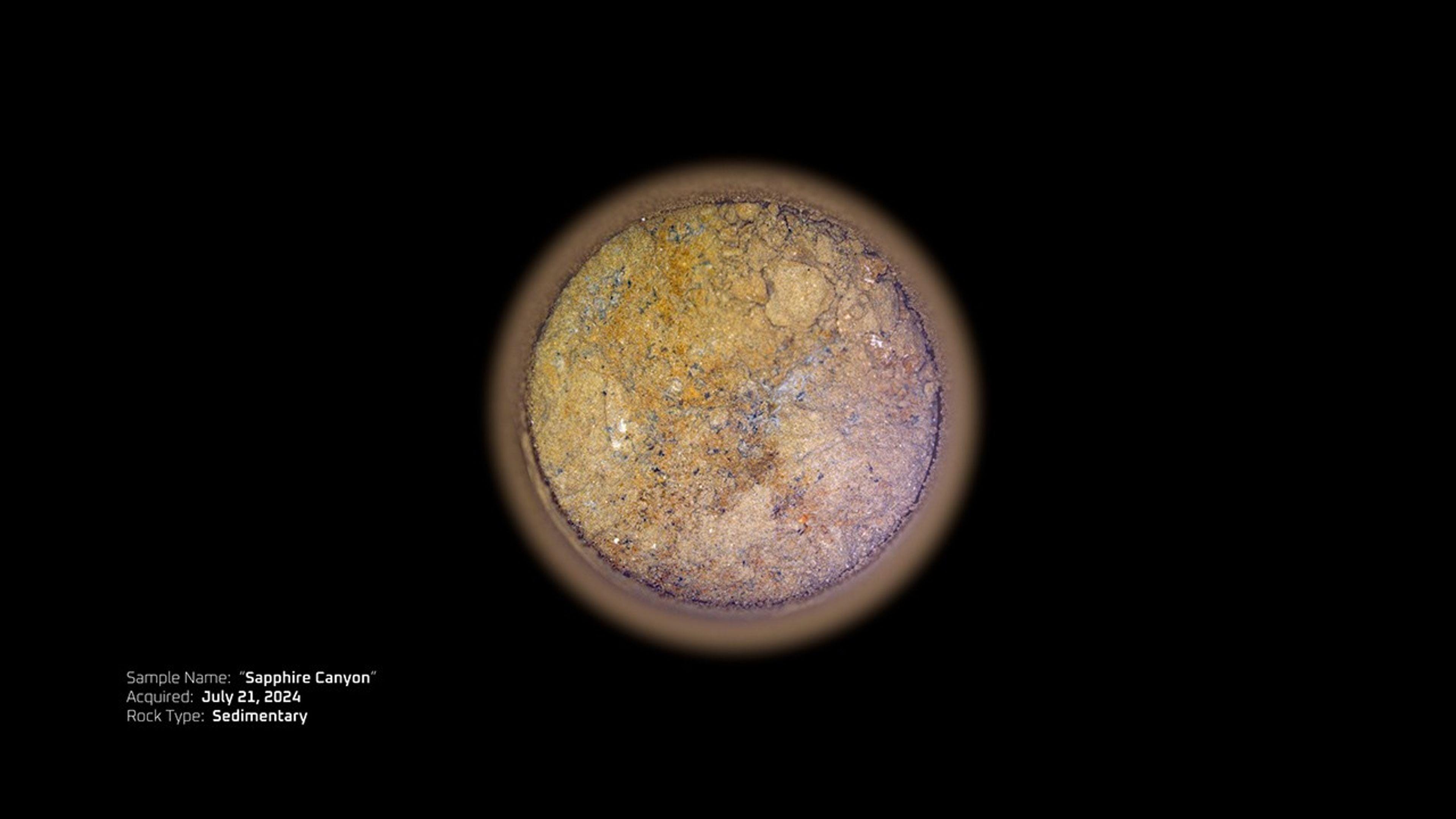
NASA may already possess one of its most significant clues in the search for extraterrestrial life. The evidence is sealed inside a sample tube aboard the Perseverance rover, millions of miles from Earth.
The sample, known as Sapphire Canyon, was collected from a Martian rock called Cheyava Falls in Jezero Crater, an area shaped by water billions of years ago. Scientists have identified chemical and mineral patterns that could be consistent with ancient microbial activity, making the sample a major focus of astrobiological research. However, the discovery is not proof that life existed on Mars.
The central challenge is getting the sample into laboratories on Earth, where scientists could conduct far more sophisticated tests than the rover can perform on the planet’s surface.
A Rock That Could Change Our Understanding of Life
The Sapphire Canyon sample came from the Bright Angel formation, a region containing sedimentary rocks formed in an environment associated with ancient water. On Earth, similar clay- and silt-rich materials can preserve traces of ancient microorganisms.
NASA scientists identified a combination of organic carbon, sulfur, phosphorus and iron-bearing minerals in the rock. Researchers also observed distinctive patterns that could have resulted from chemical reactions potentially associated with microbial activity.
The findings were published in the scientific journal Nature in September 2025. The research team described the evidence as a potential biosignature — a feature that could indicate past or present life but can also have a nonbiological explanation.
That distinction is crucial. Organic compounds are not exclusive to living organisms, and geological processes can produce some of the same chemical signatures. Scientists therefore need additional testing to determine whether the sample preserves genuine evidence of biological activity.
Why NASA Cannot Get a Definitive Answer on Mars
Perseverance is equipped with sophisticated scientific instruments, but its capabilities have limits. It can analyze rocks and transmit measurements and images to Earth, yet it cannot reproduce the full range of laboratory tests available to researchers working with physical samples.
Returning the material would allow scientists to use advanced instruments to investigate its chemical composition, microscopic structures and potential biological signatures in much greater detail.
NASA and the European Space Agency previously developed the Mars Sample Return program to accomplish that goal. However, the ambitious mission faced mounting costs, technical complexity and delays.
The program’s original architecture was projected to cost as much as $11 billion, with the anticipated return date slipping as far as 2040. NASA subsequently began winding down the program after its existing plans were deemed unaffordable, leaving the collected samples without a confirmed return mission.
The Race to Bring Martian Samples Back to Earth
The uncertainty surrounding NASA’s plans has opened the door for other space programs to pursue their own sample-return ambitions.
China is developing its Tianwen-3 mission, which is intended to collect Martian material and return it to Earth. Current plans have pointed to a launch in 2028 and a potential return in 2031, although mission schedules and technical plans can change.
Meanwhile, NASA Administrator Jared Isaacman has publicly expressed interest in retrieving Perseverance’s samples, but a definitive new mission architecture and schedule have not been announced.
The challenge is more than a matter of transporting rocks across space. A successful return would require spacecraft capable of landing on Mars, collecting or receiving the samples, launching them into Martian orbit and delivering them safely to Earth.
Each stage involves significant engineering and financial hurdles.
What This Discovery Could Mean for Humanity
Determining whether Mars once hosted life would be one of the most consequential discoveries in modern science. It could help scientists understand whether life emerged independently on another planet or whether the conditions that produced life on Earth are exceptionally rare.
If researchers establish that ancient microbial life existed on Mars, it would demonstrate that biology developed beyond Earth — although it would not, by itself, establish whether life exists elsewhere in the universe today.
The findings could also reshape our understanding of Mars’s ancient climate, its history of liquid water and the possibility that habitable environments persisted longer than previously believed.
For now, the Sapphire Canyon sample remains on Mars, holding clues that scientists cannot yet fully interpret. The material may eventually provide answers to one of humanity’s oldest questions, but those answers depend on a future mission that has yet to be secured.
The irony is striking: a rover sent to investigate whether humanity is alone may already have collected a sample capable of transforming that debate, while the technology needed to settle the question remains out of reach.