

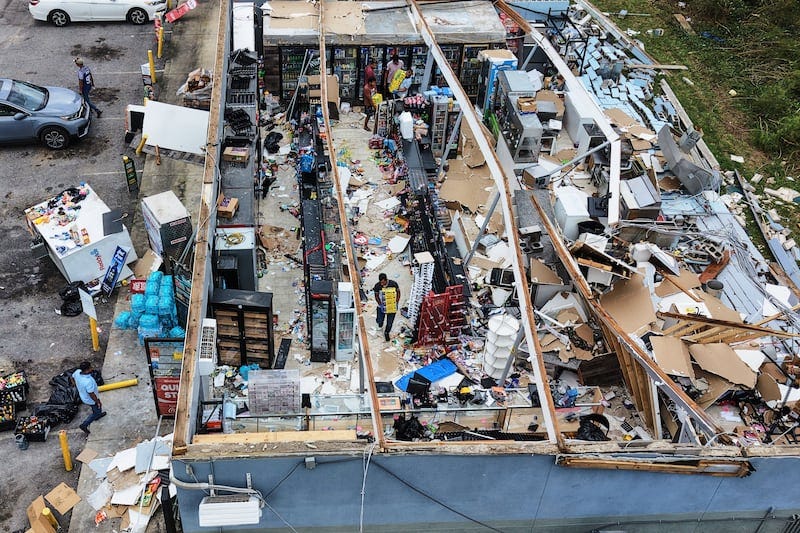
Nearly 396,000 electricity customers across Florida’s Panhandle and southern Alabama remained without power early Sunday as the remnants of Hurricane Isaias moved north, bringing continued threats of heavy rain, flash flooding and damaging wind gusts.
The storm made landfall near Destin, Florida, late Friday, October 9, with maximum sustained winds of 105 mph. It weakened after moving inland, but its impacts continued across the Southeast, where officials reported fatalities, damaged buildings, blocked roads and widespread utility disruptions.
Hundreds of Thousands Still Without Power
Utility crews continued restoration efforts Sunday across the Florida Panhandle and southern Alabama, where strong winds had toppled trees, damaged power lines and disrupted essential services.
The outage total marked a substantial reduction from the storm’s peak. Nearly 900,000 customers had lost electricity across affected areas during the height of the storm, according to the Associated Press. Florida and Alabama accounted for much of the damage, although Georgia and Mississippi also experienced outages.
Alabama’s Emergency Management Agency reported that outages in the state had fallen below 75,000 by Sunday morning. Some emergency management offices and healthcare facilities in the hardest-hit areas were still operating on generator power, and officials warned that recovery could take weeks or months in some communities.
Storm Moves Toward the Appalachians and Mid-Atlantic
Although Isaias weakened after landfall, forecasters warned that its remnants could still produce dangerous weather far from the Gulf Coast.
Heavy rainfall was expected across the central Appalachians and Mid-Atlantic, with isolated flash flooding possible in areas receiving persistent downpours. Strong wind gusts could also bring down trees and power lines, creating additional outages and travel hazards.
The National Weather Service identified heavy rainfall as a primary concern as the storm system moved north. Dangerous surf and rip currents were also expected to persist along parts of the Gulf and southeastern Atlantic coasts.
Florida Panhandle Takes the Brunt of the Storm
Isaias came ashore near Destin as a Category 2 hurricane, bringing destructive winds and heavy rain to communities along Florida’s northwestern Gulf Coast.
Damage reports included a roof torn from a Pensacola hotel, damage to the city’s airport and destruction to buildings along the coast. In Panama City Beach, part of a high-rise building’s facade was ripped away, while a boathouse in Destin was flattened.
Residents across the region faced fallen trees, debris-covered roads and damaged homes. Emergency crews worked to assess conditions and restore access to affected neighborhoods as weather conditions improved.
At Least Four Deaths Linked to Isaias
At least four deaths were linked to the storm in Florida and Alabama, according to reports published over the weekend.
Two people in Florida and Alabama were killed when trees fell onto homes. Other reported deaths included a fatal carbon monoxide incident involving a generator and a motor vehicle crash involving a downed tree.
The incidents underscore the dangers that can persist after a hurricane moves inland, particularly from unstable trees, damaged infrastructure and improper generator use. Officials have urged residents to avoid downed power lines and to operate generators outdoors, away from doors and windows.
DeSantis Prioritizes Power Restoration
Florida Gov. Ron DeSantis said restoring electricity and assessing storm damage were priorities after the hurricane passed through the state.
More than 16,000 utility workers had been deployed in Florida to assist with recovery, according to Reuters. Crews were also assessing damage to roads, bridges and other infrastructure as transportation networks reopened.
In Alabama, officials warned that downed trees and power lines continued to create dangerous conditions. Recovery efforts were expected to continue for an extended period in the hardest-hit communities.
Recovery Continues as Flood Threat Persists
Isaias weakened from a Category 2 hurricane to a post-tropical system, but forecasters warned that the storm’s rainfall and wind impacts would continue as it moved farther inland.
Residents in affected areas were urged to monitor local weather alerts, avoid flooded roads and stay clear of damaged electrical infrastructure. Even after winds subside, heavy rainfall can trigger flash flooding and falling trees can remain a threat.
For communities across the Southeast, the immediate priorities remain restoring electricity, clearing debris and assessing damage while preparing for the storm’s remaining effects farther north.