


Pakistan’s Prime Minister Shehbaz Sharif has pledged to support Saudi Arabia “in every possible way” following a series of deadly attacks attributed to Yemen’s Houthi movement, as a new regional defense agreement puts the military relationship between Islamabad and Riyadh under renewed scrutiny.
Sharif condemned attacks targeting King Khalid International Airport in Riyadh and Abha International Airport, describing them as unacceptable aggression against Saudi Arabia. He said Pakistan’s commitments under bilateral and trilateral defense agreements require it to stand firmly alongside the kingdom.
“We have a bilateral agreement, a trilateral agreement with regard to defense,” Sharif told members of his Cabinet in televised remarks, according to The Media Line.
The pledge comes as Saudi Arabia faces an intensifying campaign of missile and drone attacks and considers its response. The latest violence has also drawn Turkey into a closer supporting role under a regional defense arrangement signed by the three countries in August. Sharif Calls the Attacks a Red Line
Sharif said Pakistan would not tolerate aggression against Saudi Arabia and stressed the religious and strategic importance of protecting the kingdom.
He described the security of Mecca and Medina, Islam’s two holiest cities, as a responsibility that resonates with Muslims worldwide. He also expressed solidarity with Saudi leaders and civilians affected by the attacks.
At the same time, Sharif said he hoped the confrontation could be resolved peacefully.
His remarks indicate that Islamabad wants to demonstrate its commitment to Saudi security while leaving room for diplomatic efforts to prevent a broader regional conflict.
Pakistan’s Foreign Ministry separately condemned the targeting of civilian airport infrastructure, calling it a violation of international law and a threat to regional peace and security.
A New Defense Pact Links Pakistan, Saudi Arabia and Turkey
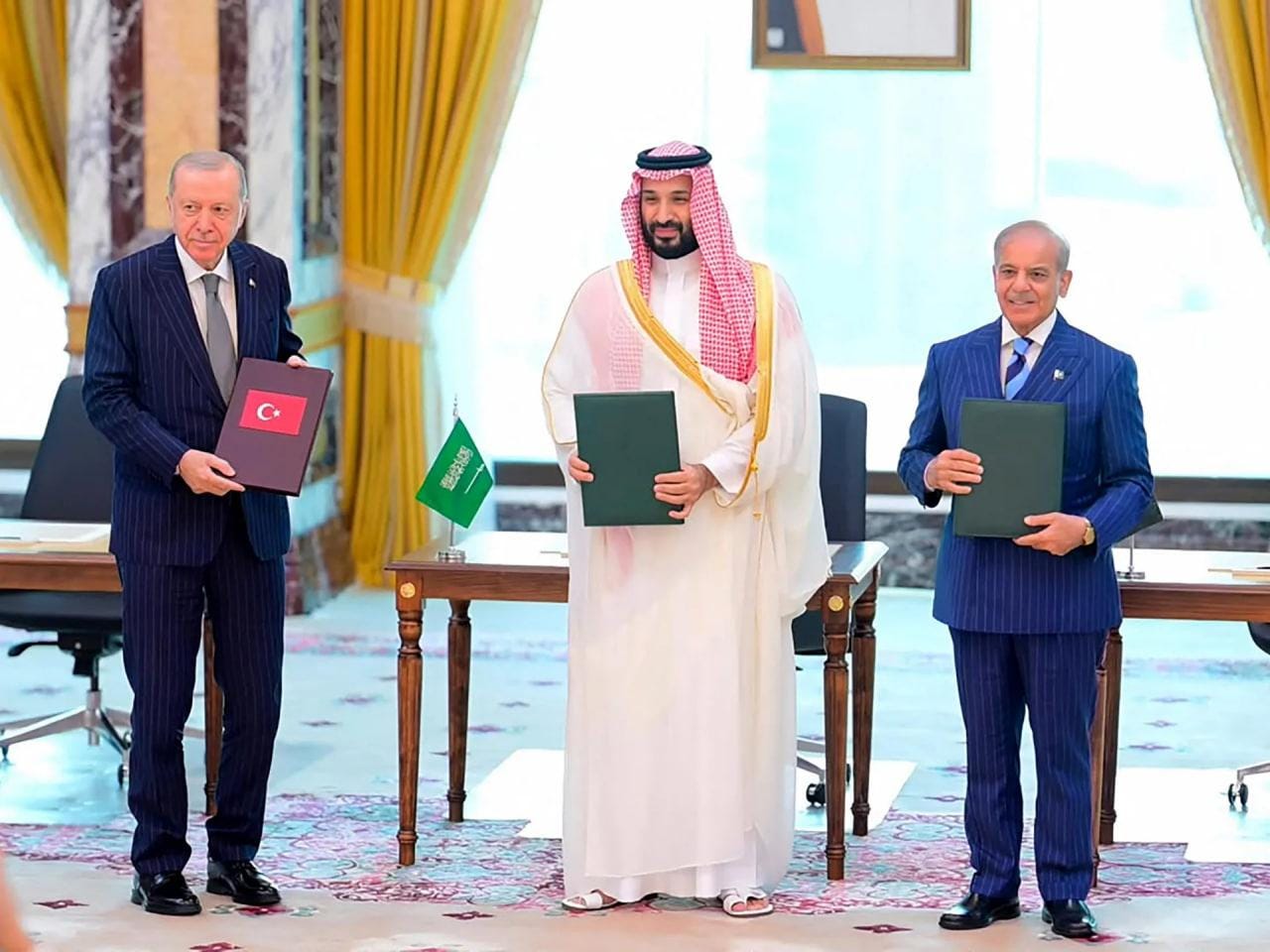
The response is unfolding under the Mecca Joint Defence Agreement, signed by Pakistan, Saudi Arabia and Turkey on August 7, 2026.
The pact states that an armed attack against one member is to be treated as an attack against all three, creating a framework for closer defense coordination among the countries.
Military leaders from the three nations have discussed intelligence sharing, military coordination and the integration of defense capabilities. The agreement has taken on greater significance as Houthi attacks threaten Saudi infrastructure and shipping routes around the Red Sea.
However, the precise operational implications of the agreement—including the circumstances under which members would participate in combat—remain important questions. A pledge of collective defense does not, by itself, establish the specific military response each country will take.
Pakistan’s military has confirmed that Pakistani forces have been deployed to Saudi Arabia under the agreement, describing their assignments as covering multiple capabilities and domains.
Deadly Airport Strikes Put Saudi Arabia Under Pressure
The Houthi attacks have struck critical civilian infrastructure in Saudi Arabia, including King Khalid International Airport in Riyadh.
Saudi authorities reported heavy casualties in the October 10 attack, with at least 12 people killed and more than 300 injured according to initial reporting. Further attacks followed, including another strike at the airport on October 11 that killed one person and injured 11, according to Reuters.
The attacks have disrupted aviation and prompted security warnings for travelers. The Houthis have also threatened further strikes against Saudi airports, while the Saudi-led coalition has reported intercepting additional missile and drone threats.
The escalating campaign is increasing pressure on Saudi leaders to respond while trying to protect civilians, maintain critical infrastructure and prevent the conflict from spreading further.
Turkey Is Providing Defensive and Technical Support
Turkey has also begun providing Saudi Arabia with technical and defensive assistance, according to Reuters.
The support includes military equipment, air-defense capabilities, intelligence and logistical coordination. Turkish officials have been involved in discussions with Saudi counterparts as the countries work through the new defense framework.
Turkey has not yet completed parliamentary ratification of the agreement, so its current assistance has been coordinated bilaterally rather than through a fully operational trilateral command structure.
The developing cooperation suggests that the pact is already influencing regional security coordination, even as the three governments continue to determine how it will function in practice.
The Houthis and the Wider Iran Conflict
The escalation is taking place amid a wider regional confrontation involving Iran, disruptions to energy shipments and fighting across Yemen.
The Houthis, an armed movement that controls much of northern Yemen, have long received support from Iran. The group’s attacks on Saudi territory have raised concerns about the security of Gulf infrastructure and trade routes, particularly the strategically important Bab el-Mandeb Strait.
Saudi-backed Yemeni forces have been fighting to regain territory near the strait, while Houthi forces have launched attacks against Saudi targets. The conflict threatens commercial shipping and adds to uncertainty in already strained regional energy markets.
Iran’s precise level of control over Houthi decisions remains contested, and the group has its own political and military objectives. Nevertheless, its attacks are increasingly intertwined with the broader regional confrontation.
Pakistan Balances Its Defense Commitments With Diplomacy
Pakistan’s pledge of support comes with potential strategic and economic consequences. A deeper military role could strengthen its relationship with Saudi Arabia and Turkey, but it could also expose Islamabad to greater involvement in a conflict that is expanding across the region.
Sharif’s emphasis on a peaceful resolution suggests that Pakistan is seeking to preserve a diplomatic path even as it reaffirms its defense commitments.
The three countries now face a central decision: how to turn their agreement into practical cooperation without triggering a wider confrontation. Their choices could affect not only Saudi security but also the future of Yemen’s conflict and the safety of trade routes linking the Red Sea to global markets.
What Happens Next?
Saudi Arabia’s response to the latest attacks, the scope of Pakistan’s military deployment and Turkey’s continued assistance will help clarify how the new defense pact operates under pressure.
For now, Sharif has delivered an unequivocal political message of solidarity with Riyadh. The extent of any additional Pakistani military involvement, however, will depend on decisions by the governments involved and the evolving security situation.
The immediate challenge for the three partners is to deter further attacks while avoiding a wider regional war. Their actions in the coming days will show whether the Mecca agreement becomes a practical collective-defense arrangement or remains primarily a framework for coordination and mutual support.