

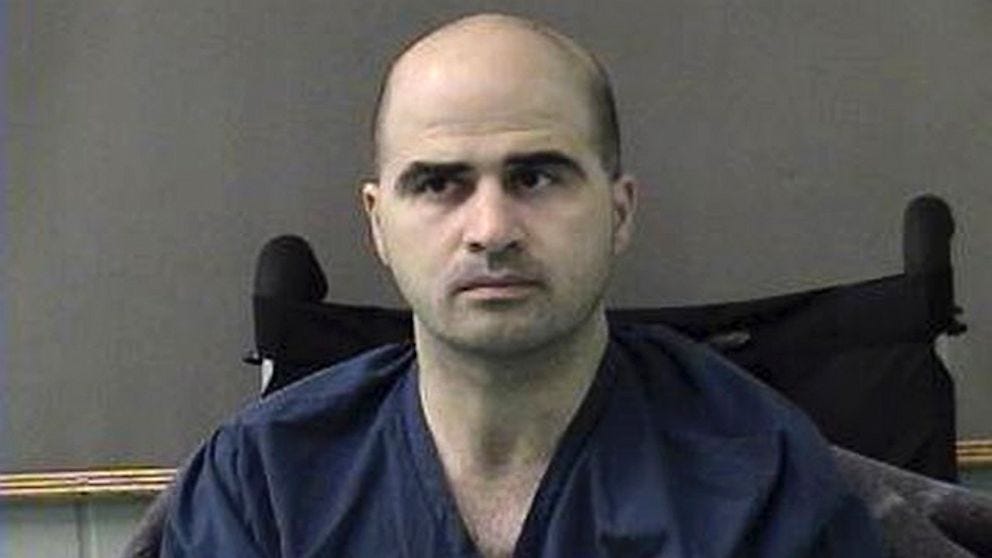
The Pentagon says it plans to livestream the scheduled execution of former U.S. Army psychiatrist Nidal Malik Hasan, who was convicted of killing 13 people and injuring 32 others during the 2009 mass shooting at Fort Hood, Texas. The announcement has sparked a wider debate over capital punishment, government transparency and whether broadcasting an execution risks turning a solemn legal proceeding into a public spectacle.
Pentagon Plans to Livestream Fort Hood Shooter’s Firing Squad Execution
The planned December 3 execution of Nidal Hasan would mark the first U.S. military execution since 1961 and an unprecedented move to broadcast an execution to the public.
The Pentagon says it plans to livestream the execution of former U.S. Army psychiatrist Nidal Malik Hasan, who was convicted of killing 13 people and injuring 32 others during the 2009 mass shooting at Fort Hood, Texas.
The execution is scheduled for December 3 at Fort Hood, the military installation where the attack occurred. Hasan is set to be executed by firing squad, following approval by President Donald Trump on the recommendation of Defense Secretary Pete Hegseth.
The decision to livestream the execution introduces a new and controversial element to a case that has remained in the military justice system for more than a decade. While officials have emphasized public visibility and accountability, legal experts have raised questions about the implications of broadcasting a government execution.
The Pentagon has said additional details about the livestream will be provided later. Associated Press reporting and Reuters reporting describe the plan as unprecedented in modern U.S. practice.
Hegseth Says the Public Should Witness the Execution
Hegseth publicly supported making the execution viewable, arguing that people should understand the consequences of the crimes for which Hasan was convicted.
The Pentagon confirmed Thursday that the execution would be livestreamed after Hegseth said in a media interview that the public would be able to watch.
The announcement represents a significant departure from modern American execution practices. Executions in the United States are generally conducted behind closed doors, with access limited to authorized witnesses, including selected journalists and representatives of victims’ families.
The last widely recognized public execution in the United States took place in 1936, when Rainey Bethea was hanged in Kentucky before a large crowd. A livestream would bring the public directly into a process that has been kept private for generations.
The 2009 Fort Hood Attack
Hasan, a former Army major and psychiatrist, opened fire at the Soldier Readiness Processing Center at Fort Hood on November 5, 2009. Soldiers were at the facility for medical processing ahead of deployment.
The shooting killed 13 people and wounded 32 others. Responding law enforcement officers shot Hasan during his arrest, leaving him partially paralyzed and dependent on a wheelchair.
Hasan represented himself during his 2013 court-martial. He was convicted of premeditated murder and sentenced to death by a military jury.
His case became one of the most consequential military criminal proceedings in modern U.S. history, and his sentence remained on appeal for years.
First Military Execution Since 1961
If carried out as scheduled, Hasan’s execution would be the first U.S. military execution since Army Pvt. John A. Bennett was hanged in 1961. It would also be the first execution by a U.S. military firing squad since 1945.
Firing squads remain an authorized method of execution in several states, although they are rarely used. The method has drawn renewed attention as states and federal authorities confront difficulties obtaining lethal-injection drugs and concerns about botched executions.
The choice of a firing squad, combined with the plan to livestream the event, makes Hasan’s case unusual even within the broader debate over capital punishment.
Legal and Ethical Questions Remain
Legal scholars and death-penalty experts have questioned whether broadcasting an execution is appropriate and what legal authority would govern the proposed livestream.
Supporters of greater transparency argue that public access could allow Americans to better understand how capital punishment is carried out. Critics counter that broadcasting an execution could turn a grave state action into a spectacle and raise concerns about the dignity of the condemned person and the purpose of the broadcast.
Military law experts have also noted that Hasan could pursue additional legal challenges that might delay the scheduled date. A possible federal habeas corpus petition could seek judicial review of the legality of his detention or execution.
The exact legal and technical arrangements for the livestream have not yet been fully disclosed.
A Historic and Controversial Decision
The Pentagon’s announcement places Hasan’s execution at the center of a renewed national debate over military justice, capital punishment and the government’s role in presenting executions to the public.
For the families of those killed and the survivors of the Fort Hood attack, the case has represented a long wait for the sentence imposed by the military jury to be carried out. For legal observers, the proposed livestream raises questions that extend beyond Hasan’s conviction to the boundaries of transparency and the public presentation of state power.
The execution remains scheduled for December 3, 2026, but potential legal proceedings could affect the timeline. The Pentagon has said further information about the livestream will follow.