

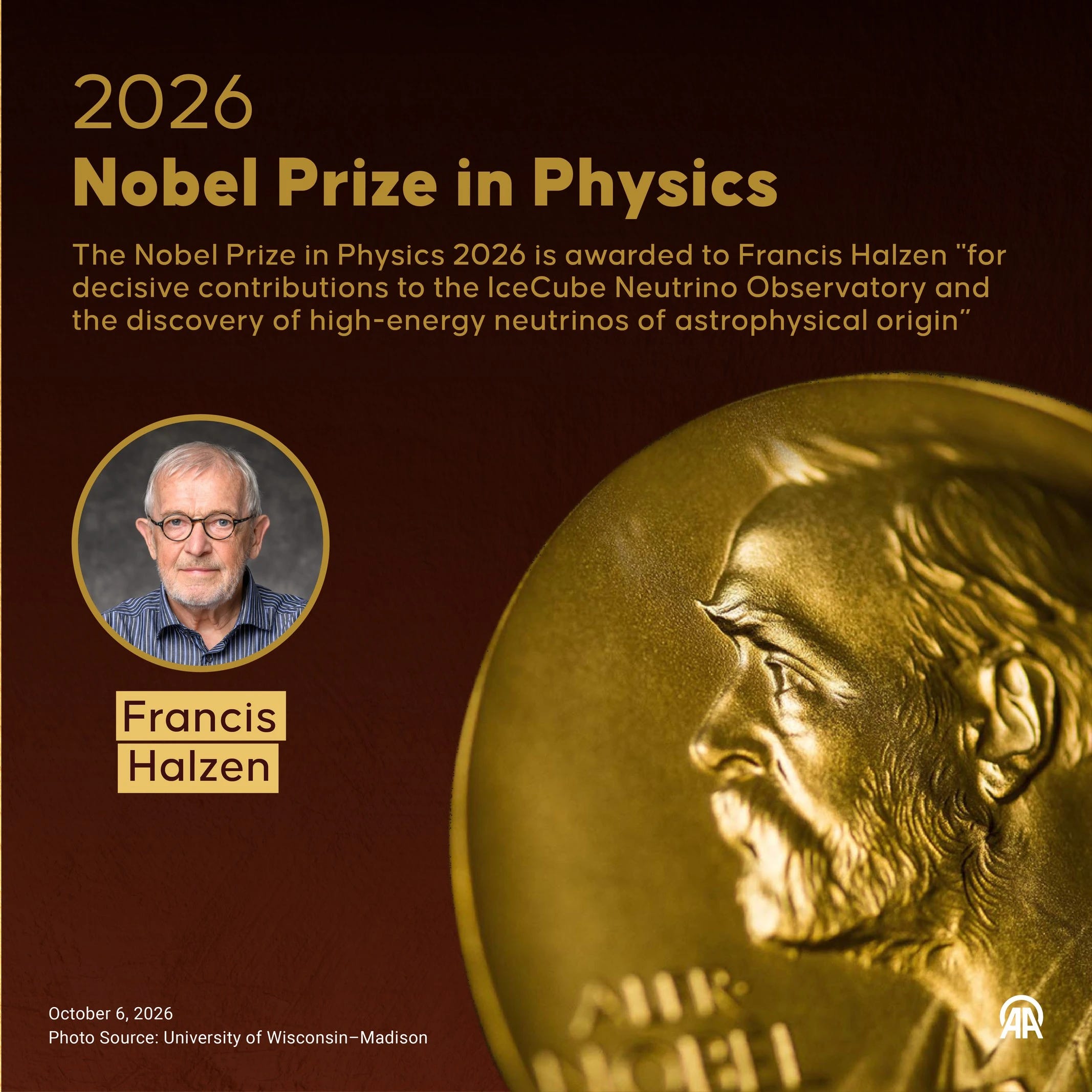
Belgian-American physicist Francis Halzen has been awarded the 2026 Nobel Prize in Physics, recognizing his monumental contributions to astrophysics and his role in uncovering some of the universe’s most elusive particles.
The Royal Swedish Academy of Sciences announced the prestigious award on Tuesday, citing Halzen’s “decisive contributions to the IceCube Neutrino Observatory and the discovery of high-energy neutrinos of astrophysical origin.” The prize comes with a monetary award of 12 million Swedish kronor (approximately $1.2 million).
Halzen, a professor at the University of Wisconsin–Madison, has spent decades pursuing the theoretical and experimental foundations of neutrino astronomy. His crowning achievement is the IceCube Neutrino Observatory, an enormous particle detector buried deep beneath the Antarctic ice at the Amundsen-Scott South Pole Station.
Neutrinos, often referred to as “ghost particles,” are incredibly difficult to detect because they carry no electrical charge and rarely interact with matter. They pass straight through the Earth—and our bodies—by the trillions every second without a trace. Halzen’s visionary idea was to use the incredibly clear, dark, and stable glacial ice at the South Pole as a massive net to capture the rare moments when a high-energy neutrino collides with an atomic nucleus.
The resulting IceCube observatory, which was completed in 2010 under Halzen’s leadership, utilizes thousands of optical sensors distributed over a cubic kilometer of ice to detect the faint flashes of blue light generated by these collisions.
“Francis Halzen has led an international team of researchers and engineers who have provided us with a fantastic instrument. His tenacity and scientific vision paved the way for a new kind of astronomy,” Mark Pearce, chair of the Nobel Committee for Physics, said in a press release.
In 2013, the IceCube team achieved a major breakthrough by confirming the first detection of high-energy neutrinos originating from outside our galaxy. This landmark discovery proved that neutrinos could be used to study cataclysmic cosmic events—such as black holes tearing apart stars, gamma-ray bursts, and active galactic nuclei—that are otherwise obscured from traditional light-based telescopes.
The Nobel committee emphasized that the continuous stream of data collected by IceCube will provide scientists with vital information about the extreme environments where these high-energy particles are created, potentially revealing previously unknown cosmic phenomena.