

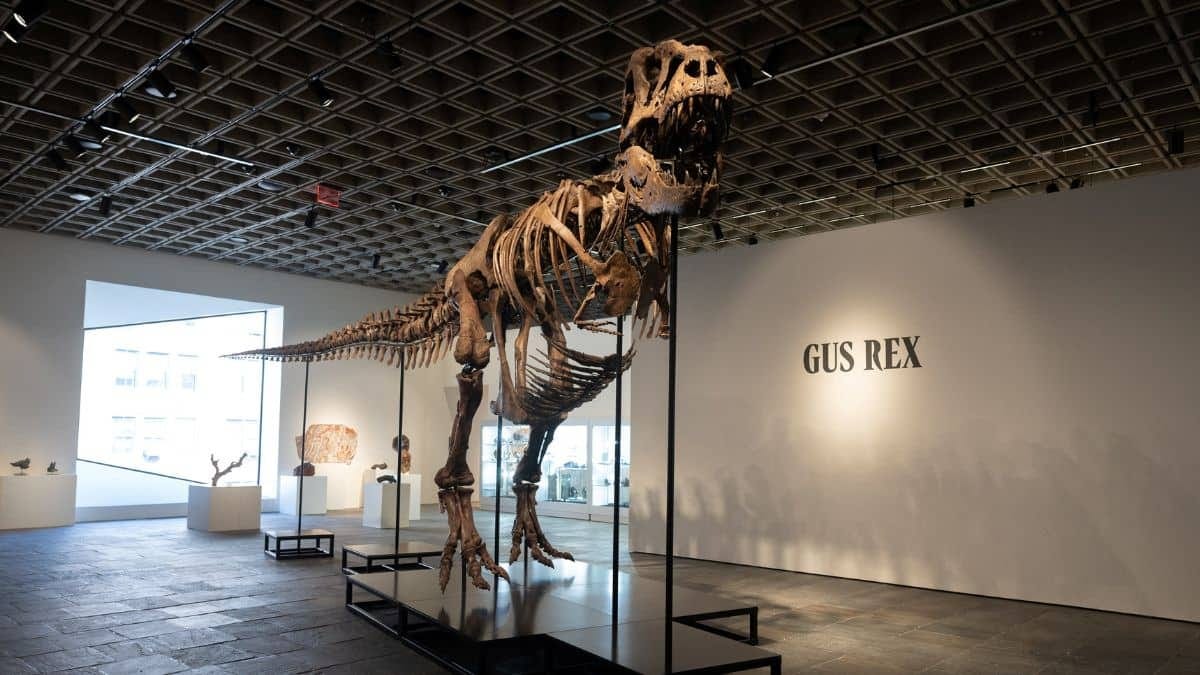
At a quick glance, the fossil unveiled Tuesday in the lobby of Sotheby’s Manhattan headquarters looks remarkably like a miniature Tyrannosaurus rex. It boasts the same terrifying, gaping jaw filled with razor-sharp teeth. But the proportions give away its true identity: the arms and legs are far too long.
This isn’t a juvenile T. rex. It is a Nanotyrannus, a smaller, nimbler predator that was recently confirmed to be a distinct, distant cousin of the famous “King of the Tyrant Lizards.”
Standing 6.5 feet (2 meters) tall and stretching nearly 20 feet (6 meters) long, the exceptionally rare fossil is one of only three such skeletons known to exist. It will remain on view at Sotheby’s ahead of an October 27 auction, where it is estimated to fetch between $6 million and $9 million.
For decades, paleontologists fiercely debated whether the Nanotyrannus was simply a young T. rex. The controversy began with the 1942 discovery of the “Cleveland Skull,” the first known head of the creature. However, groundbreaking research published in October 2025 examined the growth rings within preserved bones, confirming that these dinosaurs were fully formed adults, not juveniles.
“What’s really exciting is that until they proved this genus existed, we thought that T. rex was the only apex predator of the Cretaceous,” said Cassandra Hatton, head of science and natural history at Sotheby’s. “We now know that they coexisted. They lived alongside each other, occupying distinct niches in the ecological system.”
Hatton likened the dynamic to modern-day African predators. “It’s like a lion and a cheetah. They hunted different prey. They were around at the same time. It’s possible T. rex ate these.”
While an adult T. rex was a massive, lumbering giant that crushed the bones of slower prey, the Nanotyrannus was roughly half its length. It featured longer forelimbs, larger hand claws, and slender, blade-like teeth meant to slash meat off faster-moving targets.
Nicknamed “Jodi,” the fossil currently at Sotheby’s is billed as the “finest and most complete” Nanotyrannus available. It is almost 70% complete and boasts a virtually intact skull featuring roughly 50 teeth. The dinosaur was discovered in 2019 by Montana rancher Jodi Pierson—who the fossil is named after—and its excavation was featured on the Discovery Channel series Dino Hunters.
However, the impending sale has reignited a contentious debate within the scientific community. The Society of Vertebrate Paleontology, an advocacy group representing scientists and scholars, strongly opposes the private auction of such significant specimens, arguing they belong in museums or research institutions.
Stuart Sumida, the society’s president and a biology professor at California State University San Bernardino, voiced deep concerns over the trend of private fossil sales, especially after Sotheby’s sold a T. rex fossil for a record $50.1 million this summer.
“No peer-reviewed scientific study can be published on specimens that are not held in the public trust,” Sumida said. “Once in private hands it can never be studied, and generations of children and adults alike will never see it again.”
Sotheby’s pushes back against that narrative, arguing that the financial incentive for private diggers is essential to modern paleontology.
“These people are crucial in the preservation of science,” Hatton argued. “We don’t have enough universities and museums out there digging and doing field programs. We absolutely need private diggers who invest their own money to go do this.”