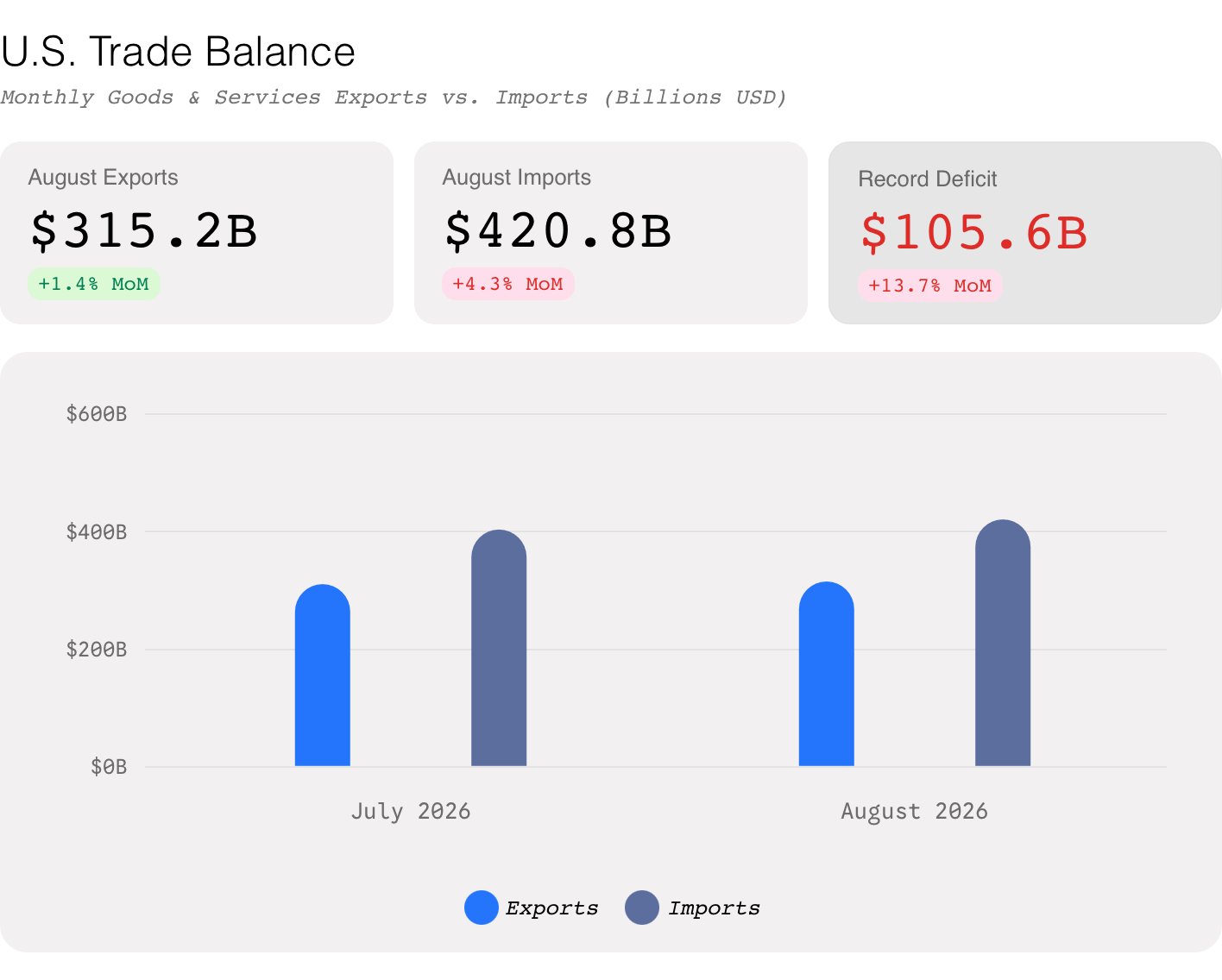
The United States trade deficit expanded sharply in August, reaching an all-time high as strong domestic demand and business spending drove a massive influx of imported goods.
According to the latest data from the Commerce Department, the U.S. trade deficit widened by 13.7% to a record $105.6 billion. The surge was primarily driven by imports, which increased 4.3% to hit an unprecedented $420.8 billion for the month. Exports also saw a slight increase, rising by $4.5 billion from July to reach $315.2 billion, but the modest gain was vastly overshadowed by the sheer volume of incoming goods.
The record imports were heavily concentrated in industrial supplies, crude oil, semiconductors, machinery, and gold. Geographically, the United States posted record goods deficits with several key trading partners, most notably Mexico, Vietnam, and Malaysia, while maintaining significant shortfalls with China, Taiwan, the European Union, and South Korea.
Economists note that the widening trade gap is expected to weigh heavily on third-quarter economic growth. Trade has subtracted from the nation’s gross domestic product (GDP) for three consecutive quarters, and early estimates suggest the August deficit could cut as much as 2.5 percentage points from Q3 GDP.
However, overall growth estimates for the July-September quarter remain largely positive, hovering above a 3.0% annualized rate. Analysts believe that the robust consumer spending fueling these imports will help offset the statistical drag from the trade imbalance. The data highlights a complex economic picture: while the soaring deficit negatively impacts headline GDP calculations, the underlying driver—a strong appetite for goods among American consumers and businesses—signals continued economic resilience.