

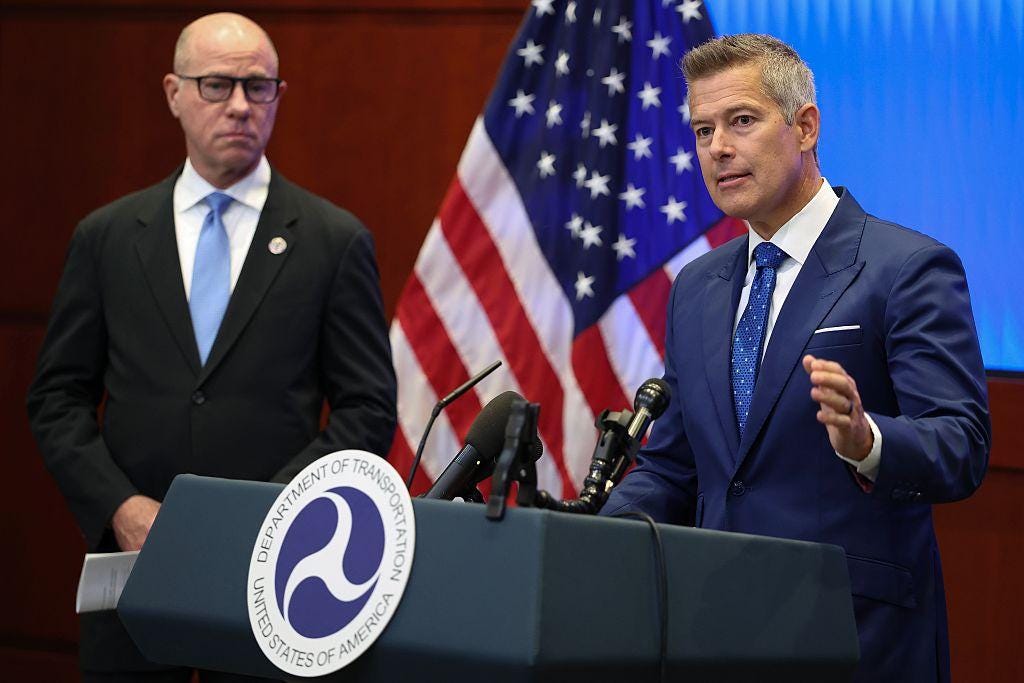
U.S. Transportation Secretary Sean Duffy said Tuesday that investigators have not yet identified the root cause of a technical failure that triggered a nationwide aviation ground stop on November 13, disrupting thousands of flights and leaving travelers stranded across the country.
Speaking to reporters on November 17, Duffy said officials had reproduced the failure but still lacked a clear explanation for why a router malfunction caused such widespread disruption to the Federal Aviation Administration’s (FAA) communications network.
“We’ve been able to recreate what happened in El Dorado,” Duffy said. “But the root cause of what happened, we don’t have clarity yet.”
The failure occurred during an effort to replace outdated copper telecommunications lines with fiber-optic technology at an FAA facility in El Dorado, Arkansas. A newly installed router began generating excessive network traffic, overwhelming parts of the system used to support aircraft communications and radar feeds.
The FAA issued a nationwide ground stop as a precaution, prioritizing the safety of aircraft and passengers while technicians worked to isolate the problem.
What happened inside the FAA network?
According to the FAA, the network experienced more than 1,000 connection attempts every four to five seconds, creating instability in communications and radar systems.
The disruption affected air traffic control operations at multiple facilities. Duffy previously said the problem involved 17 of the country’s 22 regional air route traffic control centers, which help manage aircraft traveling between airports.
At the time the ground stop was ordered, more than 3,500 aircraft were in the air, according to the Transportation Department.
The FAA said the nationwide ground stop began at approximately 3:30 p.m. Eastern on November 13. Air traffic operations resumed after the system was stabilized, with the ground stop lifted at approximately 8:15 p.m.
Contractor error or faulty equipment?
Investigators are examining whether the disruption resulted from an installation error by contractor L3Harris Technologies or a defect involving the newly installed router.
The router was reportedly the 69th installation of its type. Duffy said the previous 68 installations had operated without comparable problems.
The Transportation secretary said officials would share their findings once the investigation establishes what happened. He also addressed speculation about a possible cyberattack, saying intelligence partners had not indicated that the incident was caused by hacking.
FAA Administrator Bryan Bedford separately rejected suggestions that artificial intelligence was responsible for the outage, describing that speculation as unfounded.
L3Harris is assisting with the investigation. Hewlett Packard Enterprise, which owns router manufacturer Juniper Networks, has said the device appeared to have operated according to its configuration. That statement has added another question for investigators: whether the problem involved the equipment itself, its configuration or the way it was installed and integrated into the FAA network.
Thousands of flights disrupted
The shutdown caused extensive disruption to commercial and private aviation.
The FAA reported approximately 12,462 flight cancellations on November 13, including more than 9,000 cancellations by major airlines. Thousands of additional flights experienced delays as airlines worked to restore normal schedules over the weekend.
The disruption affected travelers nationwide, forcing airlines to rebook passengers, issue refunds and rearrange flight schedules.
An estimate from financial research firm Bernstein put the combined cost of the outage and recovery efforts for American Airlines, Delta Air Lines, United Airlines and Southwest Airlines at approximately $345 million.
Although the FAA said the network had stabilized and flights were returning to normal, the incident exposed the consequences of a failure in infrastructure supporting the country’s air traffic system.
FAA pauses router installations
In response to the incident, the FAA paused additional installations of the Juniper routers involved in the network upgrade.
The agency also disabled the relevant functionality on existing routers as a precaution and returned to using older Cisco equipment to maintain network operations while the investigation continues.
The FAA said the initial disruption had been addressed and that the system was stable. However, officials have not yet explained why the failure occurred or established all the conditions that allowed it to spread across the network.
The agency is also reviewing its procedures for conducting maintenance and equipment replacements, including whether such work should be scheduled differently to reduce the risk of disrupting air traffic.
Duffy presses Congress for $50 billion modernization investment
The aviation crisis has intensified the debate over the condition of America’s air traffic control infrastructure.
Duffy is asking Congress to approve approximately $50.1 billion for improvements to the nation’s aviation system. The proposal includes roughly $10 billion for air traffic control modernization, alongside funding for other aviation infrastructure needs.
The administration argues that decades of underinvestment have left the FAA relying on outdated technology that must be replaced to improve reliability and safety.
The Trump administration previously secured $12.5 billion for air traffic control modernization through legislation enacted in 2025. Duffy has argued that additional investment is necessary to complete the broader upgrade.
However, lawmakers from both parties have questioned aspects of the new funding request.
Some Republicans have expressed concern about spending on airport infrastructure that they believe should be financed by the airline industry. Democrats have demanded a clearer explanation of the November 13 failure before approving additional funding.
Senate Democrats demand answers
Democratic members of the Senate Commerce, Science and Transportation Committee, led by Sen. Maria Cantwell of Washington, have called on the Department of Transportation and FAA to provide a detailed account of the failure.
In a November 16 letter, the senators argued that identifying the router involved does not establish why the failure occurred or explain why existing safeguards did not prevent the nationwide disruption.
They also questioned the pace of the copper-to-fiber conversion project. According to information cited in their letter, the broader effort involves replacing 3,648 routers, with approximately 400 devices installed and 69 operational at the time of their inquiry.
The senators requested a technical briefing involving the FAA, L3Harris and Juniper, along with additional information about the investigation and safeguards for future installations.
Their central concern is that the government should establish the cause and demonstrate that the remaining upgrades can be completed safely before expanding the project.
A critical test for America’s aviation infrastructure
The November 13 ground stop has become a major test for the FAA, the Transportation Department and the contractors responsible for modernizing the nation’s air traffic control network.
The immediate technical problem has been isolated, but the unanswered questions remain significant. Investigators must determine why a single router installation generated enough network traffic to disrupt communications and radar feeds across multiple air traffic control centers.
For Duffy, the incident reinforces the administration’s argument that the United States needs a substantial investment in modern aviation technology.
For Congress, however, the challenge is balancing the urgency of modernization with accountability for how the existing system is managed and how new equipment is installed.
Until investigators establish the precise cause, the episode remains a warning about the vulnerabilities of critical aviation infrastructure—and the importance of ensuring that modernization does not introduce new risks into a system on which millions of travelers depend.