

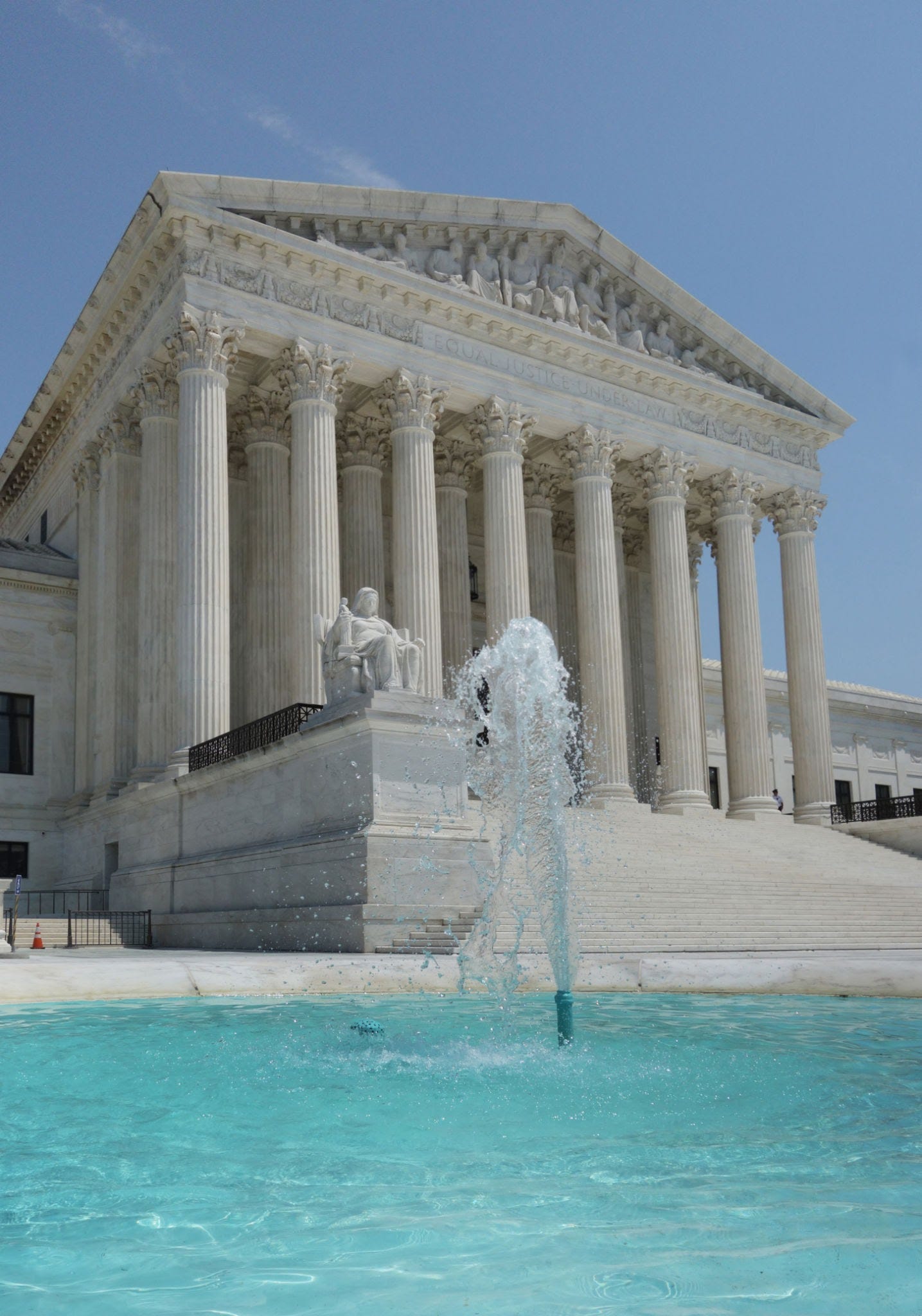
The United States Supreme Court on Tuesday declined to hear an appeal from a lawyer who was financially sanctioned while representing former Republican gubernatorial candidate Kari Lake in a lawsuit challenging Arizona’s electronic voting machines.
Without providing a written explanation for the decision, the high court’s move effectively leaves intact a 9th U.S. Circuit Court of Appeals ruling that upheld the sanctions against attorney Andrew Parker.
The legal battle stems from an April 2022 lawsuit filed while Lake was campaigning for governor and fellow Republican Mark Finchem was running for Arizona secretary of state. The suit sought to force local election officials to abandon electronic voting machines in favor of alternative counting methods for the 2022 midterms, alleging that the systems used in Maricopa and Pima counties were “vulnerable to attack and manipulation.”
Both Lake and Finchem ultimately lost their respective elections. In August 2022, a federal judge dismissed the lawsuit for a lack of standing.
Following the dismissal, U.S. District Judge John Tuchi ordered Lake’s legal team, which included Parker and fellow attorney Kurt Olsen, to pay $122,200 in sanctions. Judge Tuchi determined that the legal claims were entirely frivolous and intended to undermine confidence in the election process.
“Failing to impose meaningful sanctions here might very well encourage others to follow suit by lending their credibility to documents filed in court without facing any real consequence if their certifications prove hollow or incomplete,” Judge Tuchi wrote in his 2023 ruling. “The need for general deterrence is therefore significant.”
In their petition to the Supreme Court, Parker’s legal representation argued that upholding the financial penalty would chill future litigation. Attorney Nathan Lewin warned that the sanctions would “close the door to creative, aggressive, or novel claims” if courts penalize arguments they view as contrary to public policy.
However, attorneys representing Maricopa County firmly pushed back against the notion that the sanctions were politically motivated.
“Petitioners were sanctioned because they made objectively false and misleading statements in documents that they signed and filed in a federal district court,” Maricopa County’s legal team argued, adding that Lake’s lawyers “unreasonably and vexatiously multiplied the proceedings” by actively ignoring warnings that their claims were baseless.
The Supreme Court had previously rejected a separate request by Lake and Finchem to revive the underlying lawsuit earlier in 2024. Olsen, who was sanctioned alongside Parker, was not listed as a party in this latest petition.