

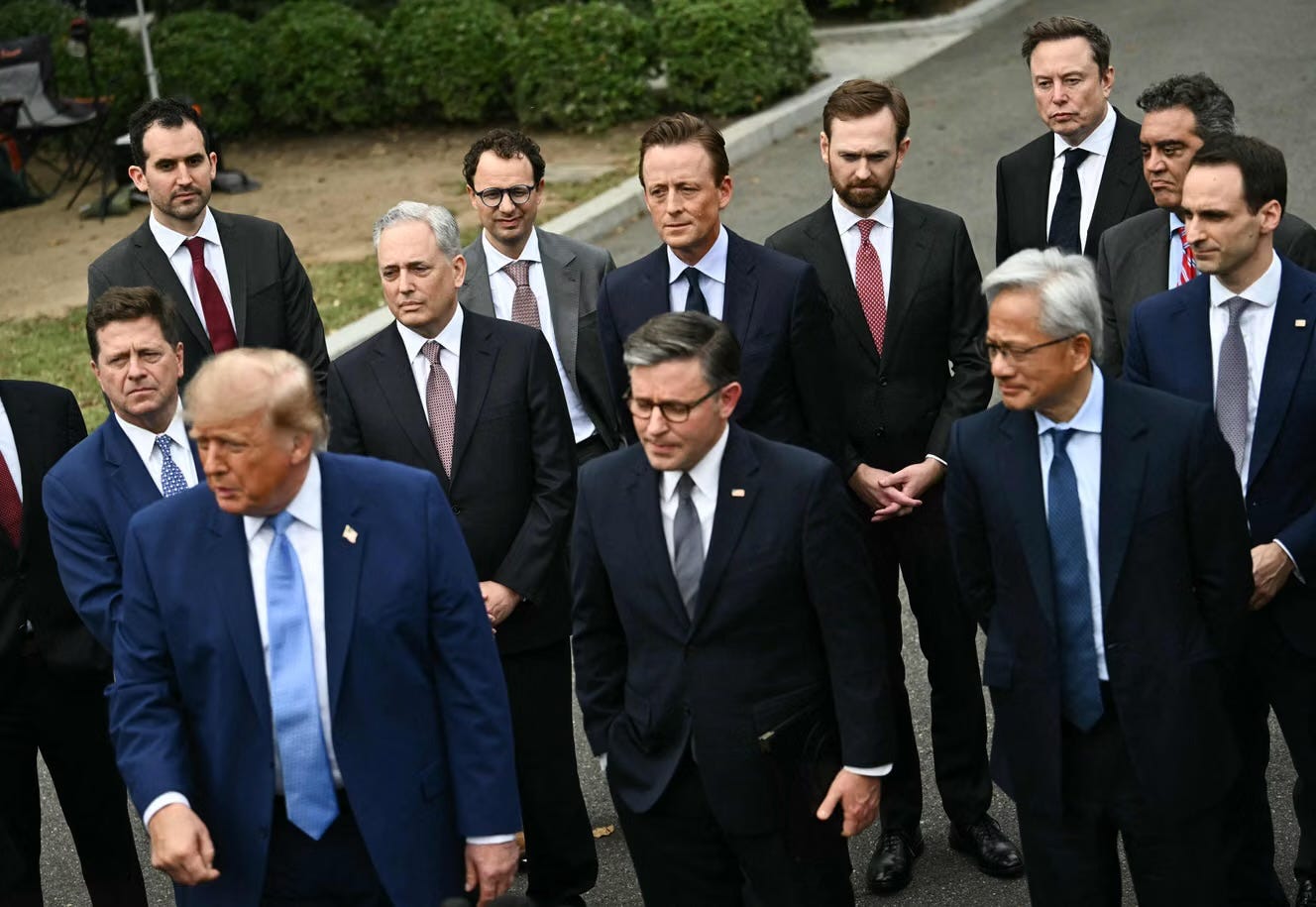
President Donald Trump has officially unveiled the text of a new voluntary agreement focused on the safe development of artificial intelligence, describing the document as a “morally binding” pact and a “constitution” for the tech industry.
The document, officially titled “The White House Accord on Super Intelligence,” outlines a joint commitment to safety and frontier responsibilities without imposing strict federal regulations. House Speaker Mike Johnson characterized the pact as a critical statement of principles that remains entirely “voluntary on behalf of the industry,” echoing the administration’s continued push for a hands-off, self-policing approach to America’s rapidly growing tech sector.
The brief accord features the signatures of just six massive industry players, representing the absolute pinnacle of current AI development: Google CEO Sundar Pichai, Anthropic CEO Dario Amodei, Meta CEO Mark Zuckerberg, OpenAI President Greg Brockman, xAI founder Elon Musk, and Nvidia CEO Jensen Huang.
During the rollout at the White House, Trump leaned heavily into his deregulatory instincts, promising “tremendous self-regulation” for the companies involved. When addressing the potential for strict government oversight, Trump simply asked, “Why would I want to do anything?”
However, the reliance on corporate goodwill has immediately sparked intense backlash from lawmakers demanding concrete, enforceable guardrails. Sen. Elizabeth Warren (D-Mass.) quickly lambasted the voluntary framework, warning on social media that trusting the tech sector with self-regulation is “a recipe for disaster.”
As AI laboratories inch closer to achieving what the Trump administration frequently refers to as “super intelligence,” the debate over whether morally binding promises are sufficient to contain unprecedented technological risks remains fiercely contested in Washington.