

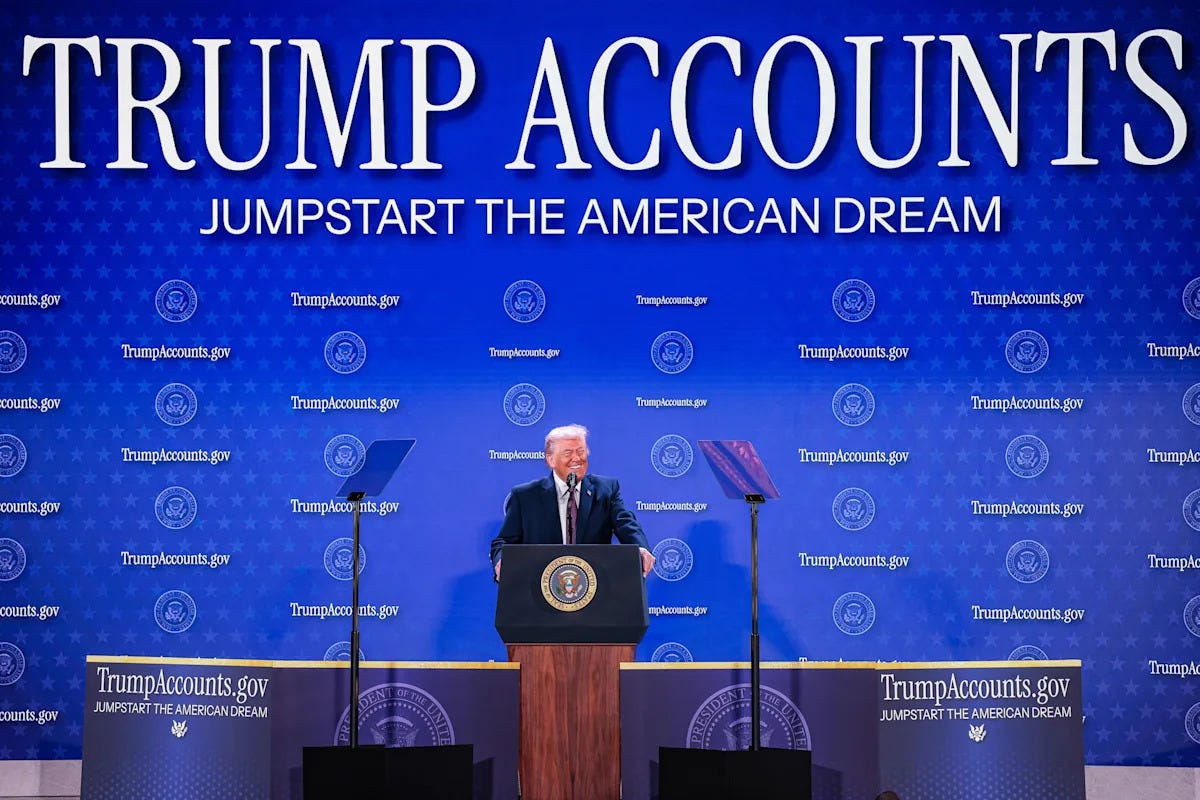
The U.S. Treasury Department is rolling out a major change to the newly created “Trump Accounts” program, announcing that it will begin automatically enrolling up to 60 million eligible children starting October 1, 2026.
The shift to automatic enrollment marks a significant expansion of the federal initiative. Previously, parents or guardians were required to actively sign up for the tax-advantaged investment accounts, which are formally known as 530A accounts and were created under the sweeping “One Big Beautiful Bill Act” signed into law in July 2025.
Under the program, every American child born between January 1, 2025, and December 31, 2028, receives an initial $1,000 seed deposit from the U.S. Treasury. The funds are automatically invested in American companies and exchange-traded funds (ETFs) and can grow tax-free. Parents act as sole custodians and can contribute up to $5,000 annually until the child turns 18, at which point the funds can be withdrawn for education, purchasing a home, or rolled into a retirement account.
According to guidance recently published in the Federal Register, the Treasury and the IRS have finalized a “master group trust structure.” This framework allows the government to automatically generate the accounts while legally protecting the families’ tax return information from the private investment managers handling the funds.
The switch to auto-enrollment was driven in part by a desire to distribute massive private philanthropic contributions more equitably. Recently, Dell Technologies CEO Michael Dell pledged $6.25 billion to the initiative. Treasury regulations noted that donors strongly preferred their financial contributions reach all eligible children across the country, not just those whose parents had the time or awareness to manually opt-in.
Treasury Secretary Scott Bessent noted during a September hearing before the House Financial Services Committee that approximately 7 to 8 million children had already joined the program. With the new auto-enrollment mechanism activating, that number is expected to balloon to over 60 million almost immediately. Moving forward, the department estimates that the automated system will add roughly two million newborn accounts each year.
Proponents of the program, including President Trump and Secretary Bessent, have championed the accounts as a critical tool for building long-term financial security, promoting financial literacy, and providing a powerful head start on wealth generation for working-class families.
However, the initiative has also faced criticism. Some political commentators and online critics have expressed skepticism regarding the government’s ability to automatically enroll citizens in a financial program, comparing it to automatic draft registration. Others have voiced concerns that the accounts represent a long-term conservative strategy aimed at eventually privatizing Social Security by forcing wealth generation into the stock market rather than relying on federal safety nets.
Despite the political debate surrounding the program’s origins and long-term implications, the auto-enrollment phase will proceed this week, dramatically shifting the landscape of federally backed child savings initiatives.