

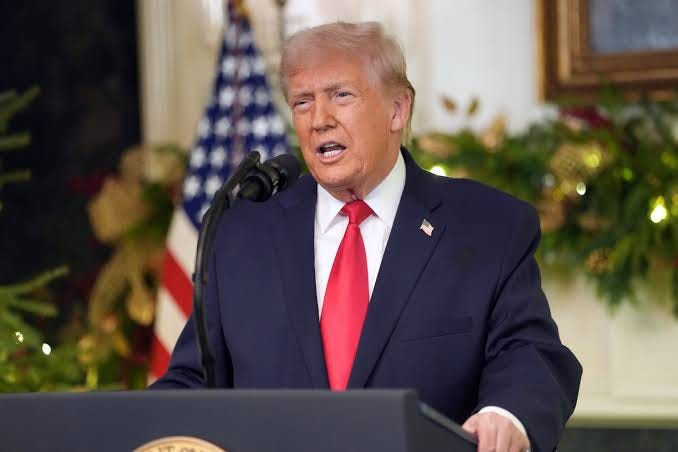
President Donald Trump has announced sweeping new plans to cement American supremacy in the rapidly evolving technology sector, outlining the creation of a new “AI Force” and his intention to appoint a dedicated “AI Czar” to lead the administration’s aggressive agenda.
The announcement signals a dramatic shift in federal technology policy, prioritizing rapid development and deregulation over the cautious safety protocols recently championed by several leading Silicon Valley executives. Trump framed the initiative as a critical matter of national security and economic survival, warning that hesitation could cede the future to foreign adversaries.
“We are not going to let other countries beat us. We will have the most powerful, most advanced artificial intelligence in the world,” Trump told supporters. “We are launching the AI Force, and we will have a new AI Czar to cut the red tape and let our brilliant innovators do what they do best.”
A Counter to the ‘Safety Slowdown’
The timing of the administration’s announcement is highly significant. It comes just days after a bombshell antitrust lawsuit accused the world’s leading AI companies—including Anthropic, OpenAI, SpaceXAI, and Google—of forming an illegal cartel to deliberately throttle the pace of AI advancement under the guise of safety.
Tech leaders like Anthropic’s Dario Amodei and OpenAI’s Sam Altman have recently argued for a coordinated “pacing of the frontier,” urging the industry to slow down capabilities until robust safety guardrails can be established.
Trump, however, has forcefully rejected these warnings. In recent weeks, he has dismissed the existential threats of rapid AI development as a “hoax” and “fearmongering.” The new AI Force is reportedly designed to counter this industry hesitation, heavily integrating artificial intelligence research with U.S. military and defense infrastructure to ensure the country maintains a decisive edge in the global arms race.
Streamlining Innovation
While specific organizational details regarding the AI Force remain scarce, administration officials indicated it will operate as a specialized task force coordinating efforts between the Department of Defense, the Department of Energy, and private sector contractors.
The proposed “AI Czar” will likely serve as a cabinet-level advisor or senior White House official tasked with dismantling regulatory roadblocks across federal agencies. According to early reports, the Czar’s primary objective will be to fast-track permits for data centers, expand domestic semiconductor manufacturing, and ensure that federal antitrust regulators do not impede the aggressive expansion of American AI firms.
The administration is expected to reveal its shortlist of candidates for the AI Czar position in the coming weeks.