

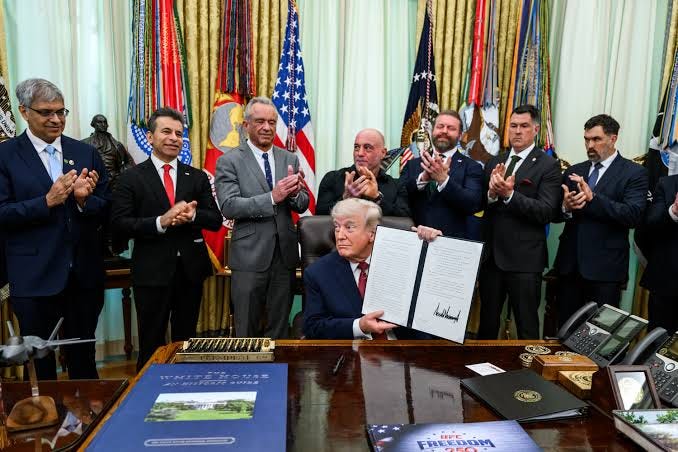
President Donald Trump moved on Friday to cancel $810 million in congressionally appropriated federal funding, explicitly targeting money tied to programs involving illegal immigrants and race-focused initiatives.
The move, first reported by the New York Post, utilizes a rare and highly controversial budget maneuver known as a “pocket rescission”. The action represents the administration’s latest effort to aggressively tighten the immigration system and redirect federal spending toward the president’s “America First” policy priorities.
Exploiting a Budget Loophole
A rescission is the cancellation of money that Congress has already appropriated but has not yet been spent. Under the standard process established by the 1974 Impoundment Control Act, a president can ask Congress to rescind funds, giving lawmakers 45 days of continuous session to review and act on the request.
However, a pocket rescission relies entirely on timing.
By submitting the rescission request just days before the end of the fiscal year on September 30, the White House can legally freeze the funds while Congress’s 45-day review period runs out. Once the fiscal year expires, the unspent funds automatically lapse, effectively canceling the appropriations without requiring any affirmative vote from lawmakers.
A Legally Disputed Tactic
The Trump administration argues that the maneuver is entirely within the bounds of executive authority.
However, the nonpartisan Government Accountability Office (GAO) has historically concluded that the Impoundment Control Act does not permit a president to unilaterally withhold funds through their expiration date to force a cancellation. The congressional watchdog agency characterizes the practice as an illegal impoundment that skirts Congress’s constitutional power of the purse.
Despite the GAO’s stance, the legal status of the pocket rescission remains murky. The Bipartisan Policy Center noted that no federal court has ever definitively ruled on the merits of whether the 1974 law permits the tactic. The Trump administration previously utilized a similar pocket rescission in August 2025 to freeze nearly $5 billion in foreign-aid funding. While that action faced legal challenges, the Supreme Court allowed the administration to continue withholding the funds while litigation proceeded, without resolving the underlying question of the maneuver’s overall legality.