

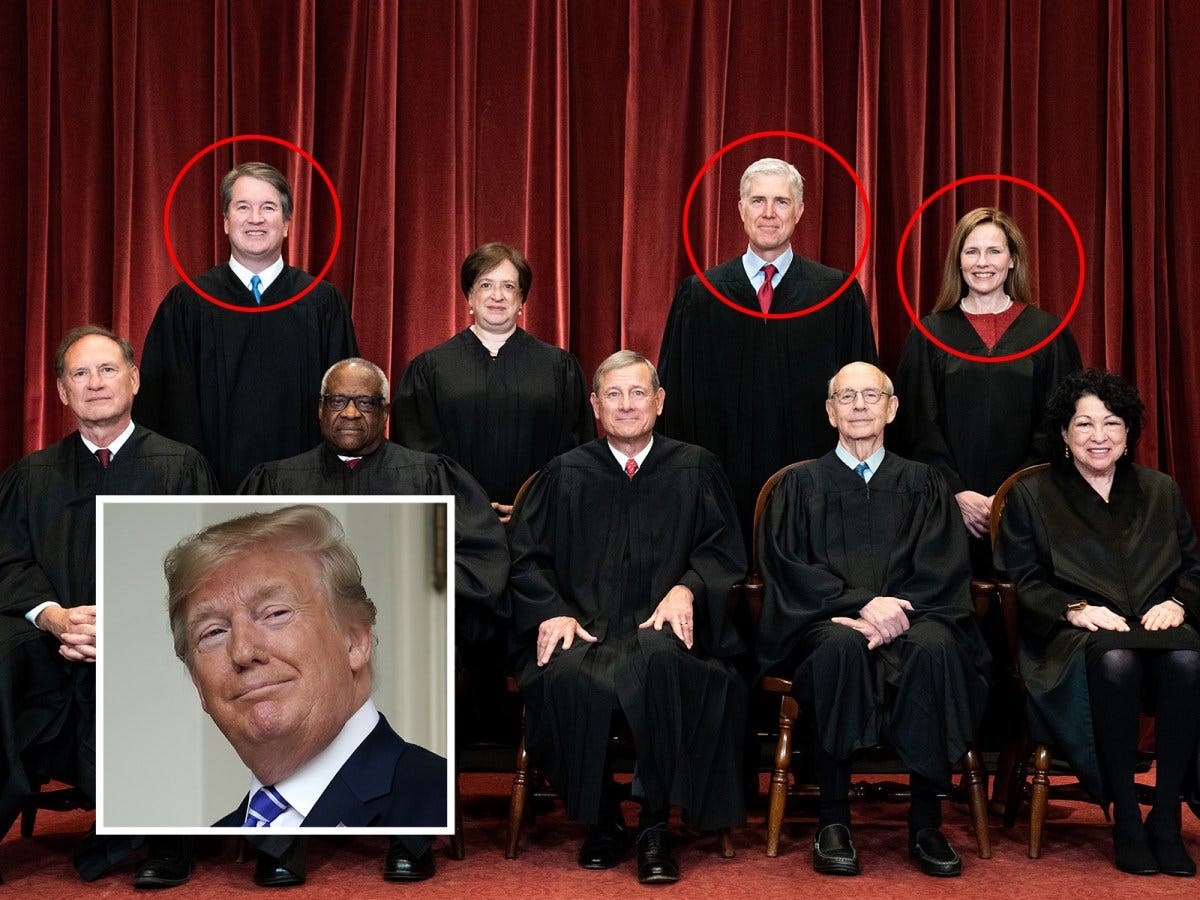
President Donald Trump recently admitted that he regrets appointing conservative Justices Neil Gorsuch, Brett Kavanaugh, and Amy Coney Barrett to the Supreme Court.
During a wide-ranging interview with TIME magazine conducted at the White House earlier this week, the President was directly asked if he regretted elevating the trio to the nation’s highest court.
“Yeah. Yeah,” Trump responded. “What can I do? I put them in. They voted against me too often. I was very — I gave them the position of a lifetime, and they vote against me often.”
While Trump acknowledged that the justices sometimes vote in his favor, he expressed deep frustration over their independence, contrasting their behavior with the perceived loyalty of the court’s liberal justices.
“You can come up with the worst thing in the world and they’ll vote as a group,” Trump said of the liberal wing. “And while I don’t like it, there’s something I admire about it: there’s loyalty.” He further claimed that the liberal justices “have loyalty to Barack Hussein Obama” and “loyalty to [Joe] Biden,” arguing that it is “unfortunate” his own appointees have not demonstrated similar allegiance.
When pressed on whether he expected personal loyalty from his nominees, Trump stated he only wanted “good decisions,” but proceeded to heavily criticize several recent rulings that went against his administration.
The President specifically singled out a major Supreme Court decision striking down his administration’s tariff strategy, a ruling he deemed “disastrous for the country.” He also heavily criticized a decision regarding birthright citizenship, arguing it has become a “corrupt business.”
“They’ve treated me – look, I put these people in. It is what it is. Very disappointing, very disappointing for the country – their decisions,” Trump added.
The three conservative justices—Gorsuch, Kavanaugh, and Barrett—were all appointed during Trump’s first term in office, cementing a 6-3 conservative supermajority on the court that was widely viewed as one of his administration’s most significant lasting achievements.