

Two Contrasting Messages From the White House
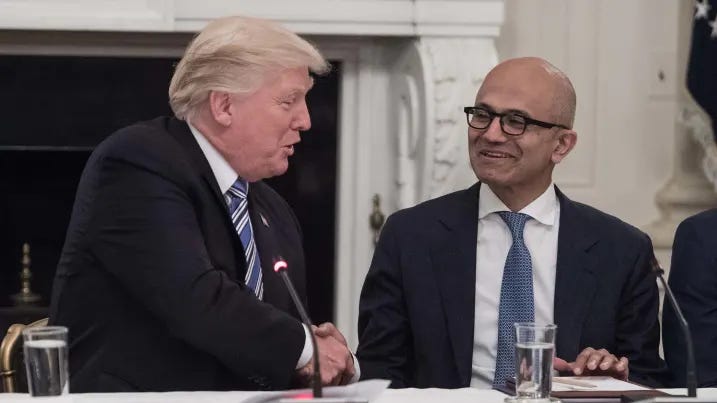
Microsoft CEO Satya Nadella experienced a striking contrast in Washington on Thursday, October 8. Vice President JD Vance announced that the administration was suspending Microsoft from a federal program used to sponsor foreign workers for permanent residency. Later that day, President Donald Trump presented Nadella with the National Medal of Technology and Innovation.
The timing highlighted competing priorities within the administration: recognizing the contributions of major technology companies while pursuing a tougher approach to employment-based immigration.
At the award ceremony, Trump recognized Nadella’s role in Microsoft’s technological development, including its work in artificial intelligence. The president did not publicly address the visa dispute during the presentation.
Vance Accuses Microsoft of Replacing American Workers
At a White House news conference, Vance accused Microsoft of exploiting the employment-based immigration system. He said the company had laid off approximately 6,000 American workers while obtaining about 6,300 H-1B visas and nearly 3,000 green cards.
Vance argued that the figures raised questions about whether foreign workers were being brought in to replace Americans, potentially at lower compensation. He called for employers to prioritize qualified American workers.
Those statements represent the administration’s allegations; the announcement itself does not establish that Microsoft committed fraud. The dispute centers on how the company uses federal programs intended to help employers recruit skilled workers when qualified American candidates are unavailable.
What the Suspension Means
The measure targets the Department of Labor’s Permanent Labor Certification program, commonly known as PERM. Employers generally use this process as an early step toward sponsoring eligible foreign employees for employment-based permanent residency.
Under the process, an employer typically must demonstrate that there are not sufficient qualified and available U.S. workers for the position and that hiring the foreign worker will not adversely affect the wages and working conditions of similarly employed Americans.
Labor Secretary Keith Sonderling said the department would stop accepting new Microsoft applications and halt processing of pending applications under the program.
The suspension is not the same as a blanket cancellation of Microsoft employees’ existing visas. Nor does it, by itself, prevent the company from filing new H-1B temporary-worker petitions. However, workers who rely on employer sponsorship to pursue permanent residency could face delays and uncertainty.
Microsoft Pushes Back on the Administration’s Claims
Microsoft disputed the implication that its visa filings primarily represented new foreign hires replacing American employees.
The company said the vast majority of its U.S. workforce consists of Americans. It also said that approximately 80% of its H-1B filings were for existing employees rather than efforts to bring new workers into the country, and that H-1B employees are paid comparably to other employees performing similar work.
The disagreement reflects a broader debate over the role of skilled immigration in the American technology sector. Critics argue that employer-sponsored visas can put downward pressure on wages or displace domestic workers. Supporters say the programs help companies recruit specialized talent and sustain innovation.
Other Technology Companies Are Also Targeted
Microsoft was not the only company affected by the administration’s announcement. Adobe and several information-technology services and outsourcing companies were also suspended from the PERM program.
The administration framed the action as part of a wider effort to investigate suspected abuse of employment-based immigration programs. Officials also announced scrutiny of certain universities over their use of the J-1 exchange-visitor visa program.
The measures signal an expanded focus on employers and institutions that rely on international talent, particularly in technology and higher education.
Nadella Joins Prominent Technology Award Recipients
Nadella was among six prominent technology leaders honored by Trump at the White House. Other recipients included SpaceX CEO Elon Musk, Google co-founder Sergey Brin, Nvidia CEO Jensen Huang, AMD CEO Lisa Su and Dell Technologies CEO Michael Dell.
The ceremony celebrated contributions to American science, technology and innovation, with artificial intelligence a prominent theme. Several recipients were born outside the United States, underscoring the international backgrounds of many leaders in the American technology industry.
Trump’s recognition of Nadella proceeded despite the administration’s earlier action against Microsoft, illustrating how its technology agenda and immigration enforcement priorities can intersect in complicated ways.
A Dispute With Consequences for Skilled Workers
The immediate consequences of the PERM suspension will depend on its implementation and the circumstances of individual employees. Workers with pending applications may need legal guidance to understand how the change affects their route to permanent residency.
Immigration attorneys have also raised the possibility of legal challenges to the administration’s authority to suspend employers from the program.
The broader question remains whether stricter restrictions on employer-sponsored immigration will protect American workers as the administration intends, or make it more difficult for U.S. technology companies to retain specialized talent.
For Microsoft, Thursday’s events delivered two sharply different signals from Washington in a matter of hours: public recognition for its technological contributions and a federal action that could complicate the immigration plans of some of its employees.