

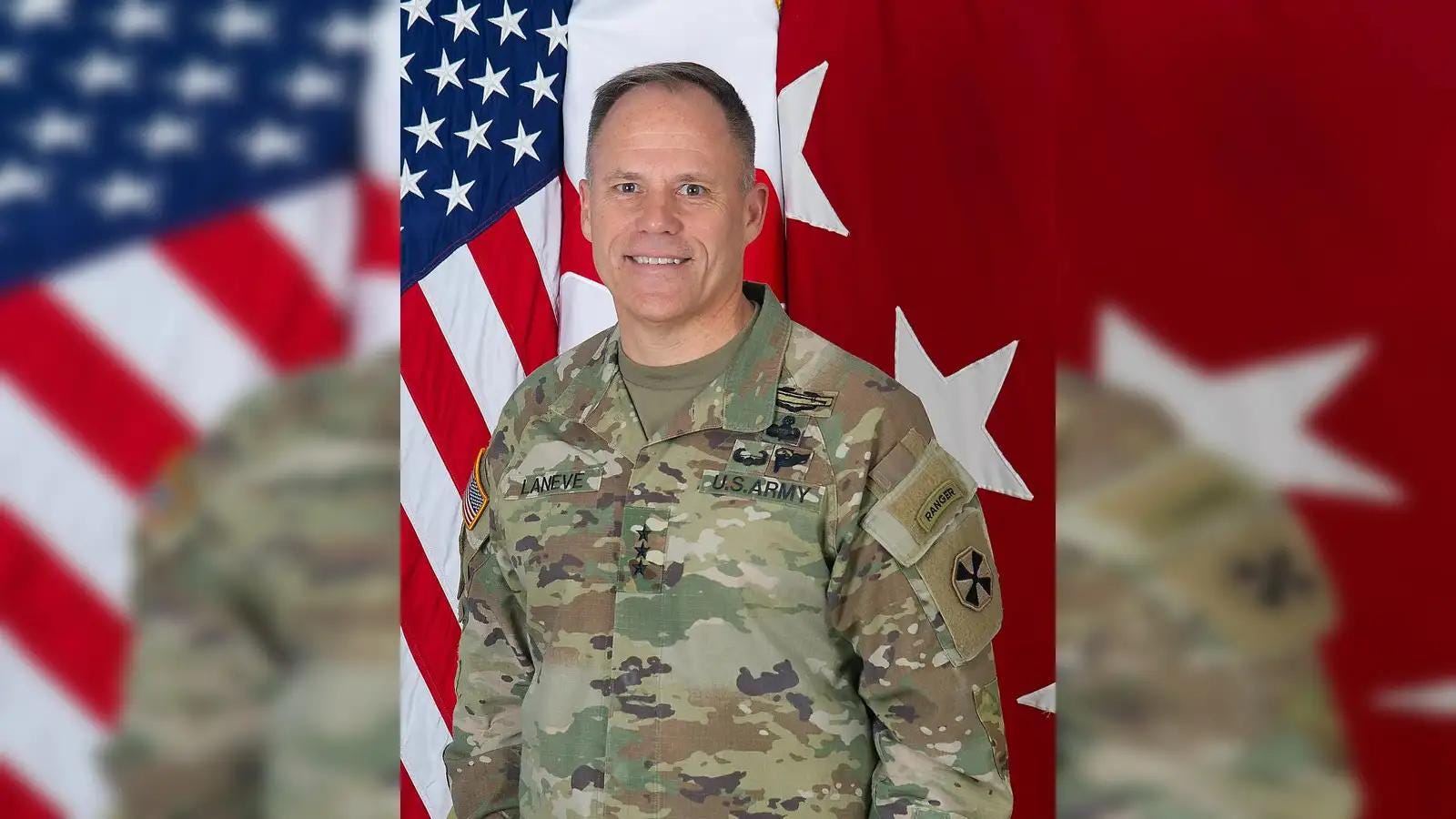
President Donald Trump has formally nominated Gen. Christopher LaNeve to serve as the next chief of staff of the U.S. Army, setting the stage for a potentially contentious Senate confirmation process as the administration continues reshaping the military’s senior leadership.
The nomination, formally submitted to Congress on November 16 and reported publicly on November 17, would place LaNeve in charge of the Army’s highest-ranking uniformed position. He has been serving as acting chief of staff since April, when Defense Secretary Pete Hegseth removed his predecessor, Gen. Randy George, without publicly providing a detailed explanation.
LaNeve’s nomination comes after months of uncertainty surrounding the Army’s leadership. Despite holding the acting position, he has not yet received permanent Senate confirmation, leaving the nation’s largest military service without a Senate-confirmed chief of staff for several months.
LaNeve’s rapid rise under Trump
LaNeve’s elevation reflects his growing influence within the Trump administration’s military leadership.
A career infantry officer with approximately 36 years of military service, LaNeve previously commanded the 82nd Airborne Division, the Eighth Army in South Korea and the Army’s 7th Army Training Command in Germany.
His rise accelerated after he was selected to serve as Hegseth’s senior military aide following Trump’s return to the White House. He subsequently became the Army’s vice chief of staff before assuming the acting chief of staff position following George’s departure.
LaNeve has already introduced significant organizational and strategic changes during his tenure.
Among them are new Army combat doctrine, an expanded emphasis on autonomous systems and a restructuring of the service’s modernization efforts. He also redesignated Army Futures Command as the Army Futures and Autonomous Systems Command, reflecting the administration’s emphasis on developing advanced military technologies.
Republican opposition could complicate confirmation
Despite Trump’s nomination, LaNeve could face resistance in the Senate, including from members of his own party.
Sen. Joni Ernst (R-Iowa), a military veteran and member of the Senate Armed Services Committee, has previously been identified as an opponent of LaNeve’s confirmation. Ernst reportedly has concerns connected to the circumstances surrounding George’s removal. George, who was confirmed in 2023, is also from Iowa.
The circumstances of George’s dismissal could become a central issue during confirmation hearings. His removal by Hegseth in April came amid reported tensions within the Army’s senior leadership, but the administration has not provided a comprehensive public explanation.
LaNeve’s close professional relationship with Hegseth and his rapid advancement through the military’s leadership structure could also attract scrutiny from lawmakers.
The nomination therefore presents the Senate with a broader question about the administration’s approach to military leadership, personnel changes and the direction of the Army.
Senate leadership transition adds urgency
The timing of the nomination could be particularly important.
Following the 2026 midterm elections, Democrats are positioned to take control of the Senate in January 2027. That creates a limited window for the Republican-controlled Senate to consider and potentially confirm LaNeve before the new Congress convenes.
If confirmation is delayed, the nomination could face a different political environment under Democratic Senate leadership.
The Trump administration has also nominated Lt. Gen. Marcus Evans to replace LaNeve as vice chief of staff. Evans currently serves as director of the Army staff and previously held senior special operations assignments, including service in Afghanistan and Iraq.
Meanwhile, the Army continues to operate without permanent Senate-confirmed civilian leadership. Former Army Secretary Dan Driscoll resigned in September, and Adam Telle is serving as acting secretary. The White House has not yet formally nominated a permanent successor.
LaNeve’s confirmation will therefore be an important test of the administration’s ability to consolidate its military leadership team while pursuing its broader modernization agenda.