

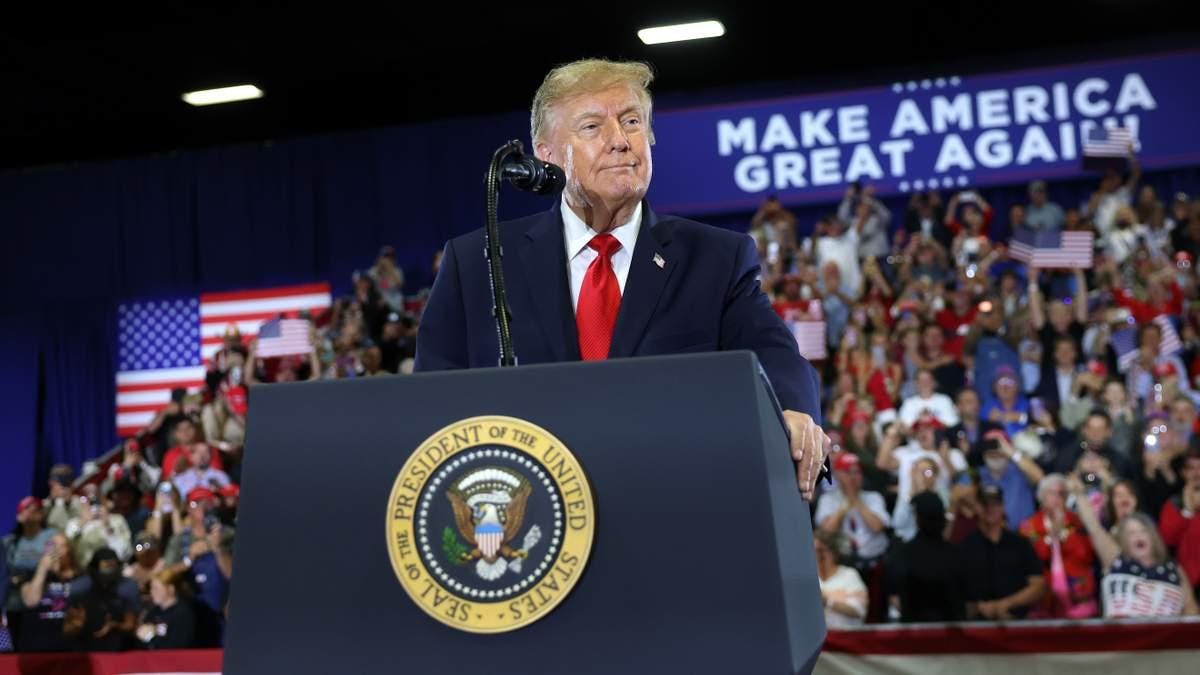
President Donald Trump said Thursday that the United States will not launch an attack against Iran before the November midterm elections, while announcing that Washington and Tehran are engaged in what he described as “productive discussions.”
Trump made the announcement in a post on Truth Social, saying the United States would refrain from attacking Iran before voters head to the polls on November 3.
The statement comes as the months-long conflict continues to weigh on energy markets, U.S. politics and the broader security situation in the Middle East.
“We are having productive discussions with the Islamic Republic of Iran,” Trump wrote.
He added that the United States would not attack Iran before the midterm elections.
Diplomacy Amid an Ongoing War
The announcement does not represent an end to the conflict or a formal peace agreement.
The United States and Iran have exchanged proposals in recent weeks aimed at ending the war and reopening the Strait of Hormuz, one of the world’s most important energy-shipping routes.
Trump has rejected Tehran’s latest proposal, while his administration continues to demand significant changes to Iran’s nuclear program.
Vice President JD Vance told Reuters earlier this week that any agreement would require Iran to make a “meaningful” reduction in its uranium-enrichment capacity.
Vance argued that Washington is looking for concrete actions rather than promises from Tehran, particularly concerning Iran’s ability to enrich uranium.
Iran Says Enrichment Will Continue
Iran’s position remains a major obstacle to a broader settlement.
Iranian state media reported Thursday that Tehran would not abandon uranium enrichment or surrender its stockpile of enriched uranium. The comments were attributed to the head of Iran’s Atomic Energy Organization.
The United States, Israel and other Western governments have long accused Iran of seeking the capability to develop nuclear weapons. Tehran has denied that it intends to build a nuclear weapon.
The disagreement over enrichment remains one of the central issues in negotiations.
Strait of Hormuz Remains a Flashpoint
The Strait of Hormuz has become another critical issue in the conflict.
The waterway carries a significant share of global energy supplies, and attacks on commercial vessels have disrupted shipping and increased concerns about oil and gasoline prices.
Reuters reported Thursday that tanker attacks in and around the Strait had reached wartime levels, while the number of vessels passing through the waterway fell to a two-month low.
Trump said the U.S. blockade of Iranian ports remains in place while oil continues to move through the Strait.
The situation has created uncertainty for global energy markets, with Gulf producers attempting to maintain exports while commercial shipping faces increased security risks.
The Midterms Add Political Pressure
Trump’s decision to rule out an attack before the elections comes as the Iran conflict has become an increasingly important political issue.
The war has contributed to higher gasoline prices and rising concerns about the cost of living — issues that could affect voters in competitive congressional races.
A recent Reuters/Ipsos poll found that 60% of Americans, including one in four Republicans, disapproved of Trump’s handling of the Iran situation.
Republicans are defending narrow majorities in Congress, making the November 3 elections particularly consequential for the administration’s ability to advance its agenda.
Reuters has also reported that Republican candidates in competitive races are increasingly distancing themselves from Trump on selected issues, including the Iran conflict.
What Happens After the Election?
Trump’s statement leaves open the possibility of military action after the midterms.
The president has previously indicated that military operations could intensify if negotiations fail, while administration officials have continued to emphasize that Iran must make substantial concessions on its nuclear capabilities.
Vance told Reuters that Washington remains open to a diplomatic settlement but said Tehran must take meaningful steps rather than simply offer assurances.
That leaves the diplomatic track vulnerable to a breakdown if the two sides cannot agree on Iran’s nuclear program, the future of the Strait of Hormuz and broader security guarantees.
For now, Trump’s announcement establishes a temporary boundary on U.S. military action: no attack on Iran before the November 3 midterm elections.
Whether that pause becomes the beginning of a diplomatic breakthrough or simply a brief lull before the conflict resumes could depend on what Washington and Tehran are able to accomplish at the negotiating table.