

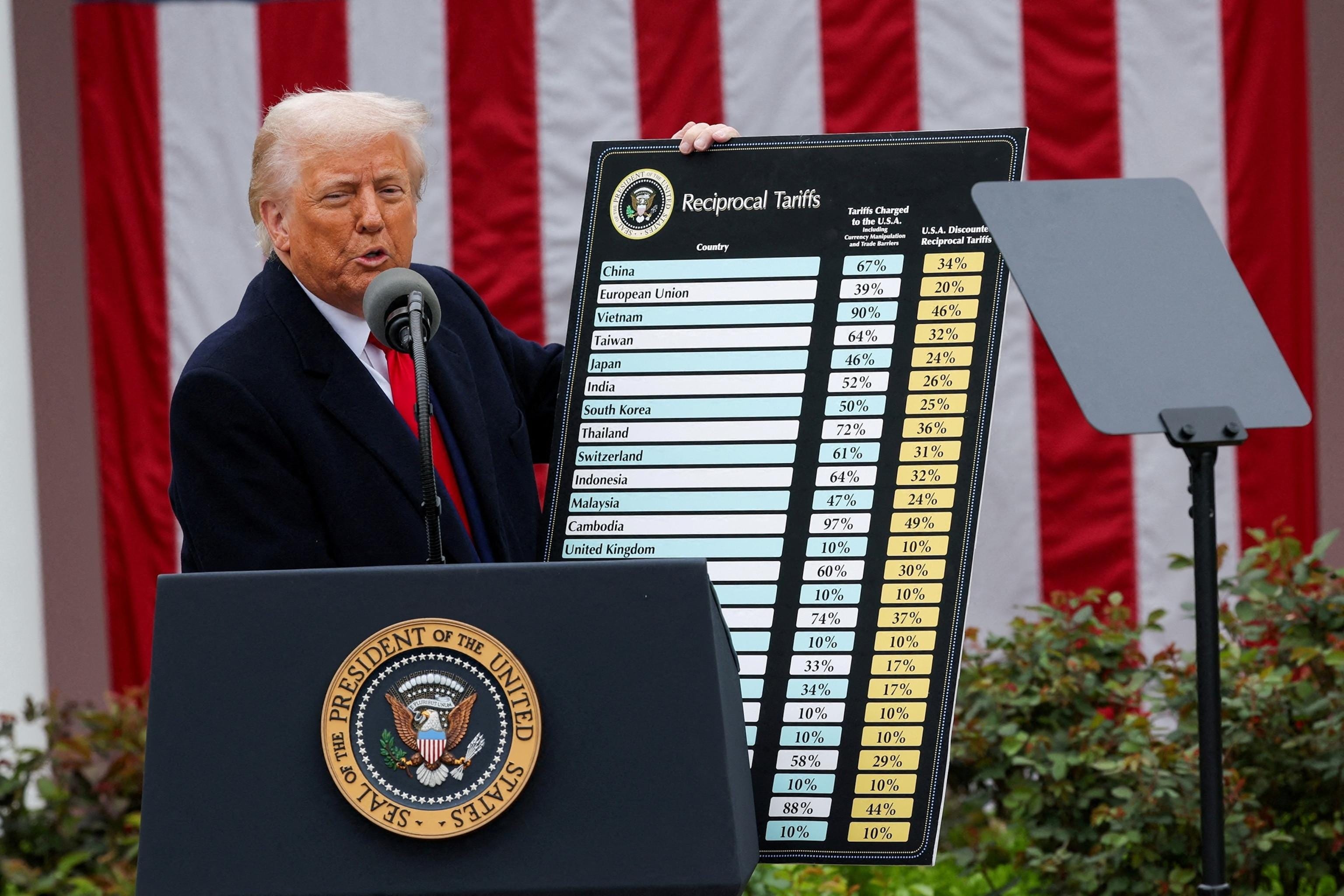
President Donald Trump is showing little inclination to retreat from his tariff agenda, even as public opinion turns increasingly critical of the import duties he has made central to his economic policy.
A recent poll found that more than 64% of Americans believe Trump has gone too far with his latest tariffs, up from 58% in January. The findings present a challenge for Republicans heading into the November 3 midterm elections, particularly as voters continue to express concern about the cost of groceries, fuel, housing and other essentials.
Trump has argued that tariffs will encourage companies to manufacture goods in the United States, protect American industries and strengthen the country’s position in global trade. His administration maintains that the policy is already helping spur domestic investment, even as economists and some business owners warn that import duties can raise costs for American companies and consumers.
Trump Keeps Tariffs at the Center of His Economic Agenda
Tariffs have become one of the defining features of Trump’s second-term economic policy. The president has repeatedly argued that foreign countries have taken advantage of the United States through trade practices that disadvantage American producers.
His administration has imposed duties on imports from a broad range of countries, including major trading partners in Europe, Asia and North America. After the Supreme Court struck down tariffs imposed under the International Emergency Economic Powers Act in February 2026, the administration turned to other legal authorities to continue pursuing its trade agenda.
One central mechanism is Section 301 of the Trade Act of 1974, which permits tariffs in response to certain foreign trade practices deemed unfair. Under the administration’s current approach, duties on imports from dozens of economies have generally ranged from 10% to 12.5%, according to the Associated Press.
The shifting legal framework has added uncertainty for businesses that depend on imported materials, overseas suppliers or predictable access to foreign markets.
Poll Shows Growing Public Opposition
The latest polling suggests that more Americans are concerned about the consequences of the administration’s tariff policies.
According to the Associated Press report, more than 64% of U.S. adults said Trump had gone too far with his latest tariffs, compared with 58% in January.
A separate Pew Research Center survey conducted September 28 through October 4 found that 56% of Americans expected the administration’s tariffs to have a mostly negative effect on the country over the coming years. Twenty percent expected a mostly positive effect, while 22% anticipated a mix of positive and negative consequences.
Republicans remain more supportive of tariffs than Democrats, but Republican views have also shifted. Pew found that 40% of Republicans and Republican-leaning independents expected tariffs to have a mostly positive impact, down from 52% in August 2025. Meanwhile, 26% said the tariffs would have a mostly negative impact, up from 17% at the beginning of 2026.
The findings point to an important distinction: Americans disagree over the long-term merits of tariffs, but concerns about their costs are not limited to Democratic voters.
Who Actually Pays the Tariffs?
Trump has frequently argued that foreign countries pay the tariffs imposed by Washington. Many economists, however, say the costs are largely borne by American importers, businesses and, in some cases, consumers.
When a U.S. company imports a product subject to a tariff, the duty is generally paid at the border by the importing business. That company can absorb the additional expense, negotiate lower prices with its suppliers, or pass some of the cost on to customers.
Research cited by the Associated Press, including work by the Federal Reserve Bank of New York and Harvard-affiliated economists, has found that foreign exporters have generally not lowered their prices enough to offset the tariffs imposed on American imports.
The result can be higher prices for businesses purchasing materials and components, as well as for households buying finished products. The extent of the effect varies by product, supplier, market conditions and the ability of companies to find alternatives.
The administration disputes the broader criticism of its approach, arguing that tariffs can encourage domestic production and reduce reliance on foreign supply chains.
White House Points to Manufacturing Investment
The White House maintains that the tariff strategy is beginning to deliver benefits through increased manufacturing activity and investment in industrial facilities.
Spokeswoman Taylor Rogers said factory construction today could translate into additional manufacturing jobs when those facilities become operational. The administration has also pointed to increases in manufacturing output and certain categories of nonresidential construction as evidence that its economic strategy is producing results.
The argument reflects the administration’s longer-term objective: make imported products less attractive, encourage businesses to build or expand U.S. facilities, and strengthen domestic supply chains.
However, the transition can take years. New factories require investment, construction, equipment and workers, while companies facing higher input costs may cut hiring or delay expansion in the meantime.
The overall impact is therefore uneven. Some domestic producers may benefit from less competition from imported finished goods, while others face higher costs because their own products depend on foreign materials or components.
Trade Partners Push Back
Trump’s tariff strategy has also strained relationships with major U.S. trading partners.
The administration’s duties have affected imports from the European Union, Canada, Mexico, Japan and India, among others. Some countries have responded with retaliatory measures, adding costs for American exporters and complicating cross-border supply chains.
Trade experts note that several of the United States’ major trading partners did not impose substantially higher average tariffs on American goods before the trade disputes escalated. For example, estimates cited in the AP report put the pre-dispute average U.S. tariff on goods from the European Union at roughly 1.47%, compared with an EU average of about 1.35% on U.S. goods.
Canada’s effective tariff rate on U.S. imports was also estimated to be lower than the corresponding U.S. rate on Canadian imports before the latest dispute intensified.
Those figures challenge the administration’s broad argument that high tariffs are necessary to respond to trading partners that consistently impose greater duties on American goods. At the same time, tariff averages do not capture every dispute involving subsidies, market access, industrial policy or individual products.
Legal Setbacks Have Not Ended the Trade Fight
The Supreme Court’s February ruling against the administration’s use of emergency powers for a major round of tariffs did not end Trump’s effort to impose import duties.
Instead, the administration shifted toward other statutory authorities, including Section 301 of the Trade Act of 1974. That law allows the government to respond to certain foreign practices it considers unfair, but it involves different legal requirements and procedures from the emergency powers Trump initially invoked.
The change has left businesses navigating an evolving set of tariffs and legal challenges. Companies making long-term investment decisions must account not only for the current rate but also for the possibility of further changes, litigation or retaliation.
The legal disputes have also made tariffs a continuing issue for Congress and the courts, even as the White House argues that the duties are necessary to protect American economic interests.
Midterms Put Economic Policy Under the Microscope
The November 3 midterm elections will take place against a backdrop of voter concerns about affordability and the direction of the economy.
A Reuters/Ipsos poll published October 9 found that 78% of respondents believed at least some responsibility for rising living costs rested with Trump’s policies. That included 64% of Republicans and 76% of independents. The survey also found that 57% of Republicans said prices were increasing faster than their paychecks. <Cite refs={[”turn759806news6”]}/>
Tariffs are not the only factor affecting household costs. Energy prices, housing expenses, labor costs and other economic conditions also influence inflation. But the findings suggest that the administration’s trade policy is increasingly being judged alongside its broader promises on affordability.
Trump continues to argue that tariffs will benefit American workers and industry over time. Critics counter that higher import costs and retaliatory measures can undermine those goals.
As Election Day approaches, the central question is whether voters will view the administration’s tariffs as a necessary investment in American manufacturing or as an additional burden on businesses and households already struggling with the cost of living.