

WORLD NEWS | DIPLOMACY | NOVEMBER 19, 2026
In a diplomatic meeting with potentially far-reaching consequences for the international order, U.S. President Donald Trump, Chinese President Xi Jinping and Russian President Vladimir Putin have agreed on a four-point declaration addressing United Nations reform, global energy supplies, international legal jurisdiction and nuclear security.
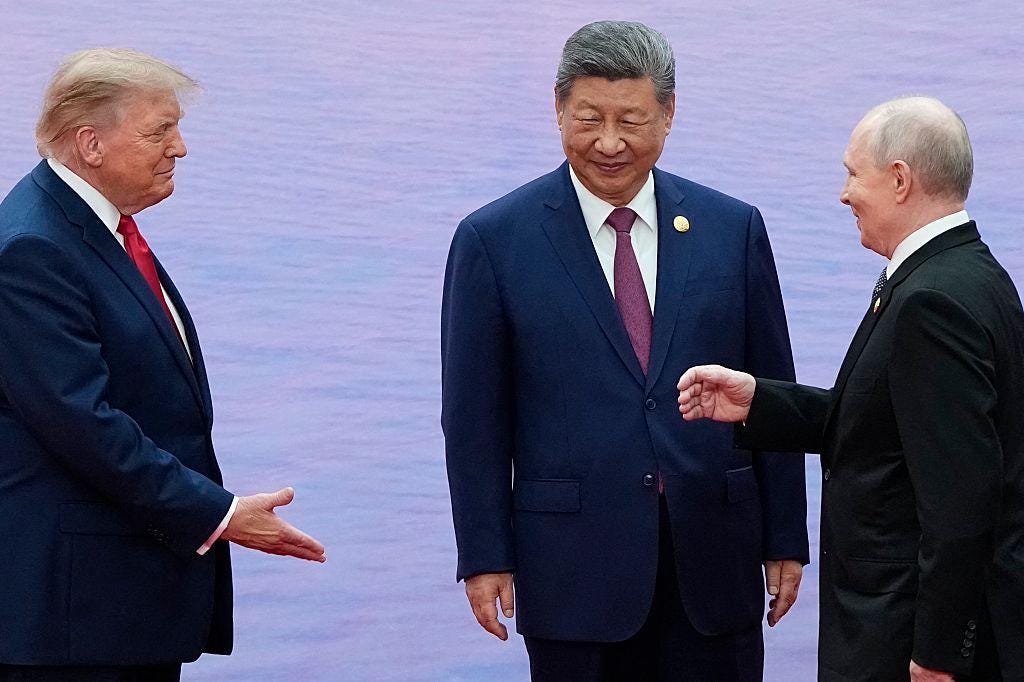
The unprecedented trilateral meeting took place in Shenzhen, China, on November 19, on the sidelines of the Asia-Pacific Economic Cooperation (APEC) summit. The discussions lasted approximately 80 to 90 minutes, bringing together the leaders of the world’s three largest nuclear powers.
The declaration, published by Chinese state media and reported by international news organizations, outlines areas where Washington, Beijing and Moscow say they can cooperate despite their significant political, economic and military differences.
Trump described the gathering as historic, emphasizing that the three countries have a special responsibility to prevent international conflicts and reduce the danger of nuclear war.
The agreement does not establish a binding treaty, but it signals an effort to create a diplomatic framework for cooperation among three governments whose relationship will have enormous implications for global security.
1. Three Powers Call for Reform of the United Nations
The first major commitment concerns reforming the United Nations.
As permanent members of the UN Security Council, the United States, China and Russia possess significant influence over international security decisions, including the ability to veto major resolutions.
Their joint declaration states that the three countries will support reforms intended to make the organization more effective in responding to global challenges and maintaining international peace and security.
The statement reflects longstanding criticism that the current international system does not adequately represent changing geopolitical realities.
Reform discussions could eventually include questions about Security Council representation, decision-making procedures and the organization’s ability to respond to major international conflicts.
However, the declaration does not specify which reforms the three governments intend to pursue or establish a timetable for implementing them.
For Trump, the commitment could provide an opportunity to reshape aspects of international diplomacy through direct engagement with the two other permanent Security Council powers.
2. Trump, Xi and Putin Pledge Increased Oil Production and Supplies
Energy security represents another important component of the agreement.
The three leaders committed to increasing the production and supply of refined petroleum products for the benefit of countries worldwide, while reaffirming the importance of stable energy flows.
The announcement comes amid international concerns about disruptions to oil transportation, geopolitical tensions involving Iran and instability affecting important shipping routes.
The Strait of Hormuz, one of the world’s most important energy transportation corridors, has become a particularly significant concern because of its role in moving petroleum supplies from the Persian Gulf to international markets.
Increased refined fuel production could help ease supply pressures, stabilize energy markets and support countries facing higher transportation and industrial costs.
The commitment is also strategically important for Russia, whose energy exports have faced extensive Western sanctions following its invasion of Ukraine.
However, the declaration does not provide production targets, specific supply commitments or details about how the three governments intend to coordinate their energy policies.
Its practical impact will therefore depend on whether the political commitment translates into measurable changes in global energy production and distribution.
3. Leaders Challenge the International Criminal Court’s Authority
Perhaps the most controversial part of the declaration concerns international justice and the authority of the International Criminal Court (ICC).
The three leaders emphasized the importance of national consent and immunity for state officials, warning that international judicial institutions should not abuse their jurisdiction.
The declaration specifically states that the ICC and similar organizations must respect these principles.
This position carries particular significance for Putin, who has been subject to an ICC arrest warrant since March 2023 over alleged war crimes involving the unlawful deportation and transfer of Ukrainian children.
The Russian president’s participation in the summit, hosted by China, places the issue of international legal accountability directly into the broader diplomatic conversation.
For Moscow, the declaration reinforces its longstanding criticism of international institutions that it considers politically motivated or excessively intrusive into national sovereignty.
For Washington and Beijing, the issue also reflects broader disagreements about the balance between national authority and international legal institutions.
The statement does not cancel the ICC warrant against Putin or change the court’s legal authority. However, its language signals that the three governments share concerns about how international judicial powers should be exercised.
The position is likely to generate criticism from human rights organizations and governments that support the ICC’s role in prosecuting alleged war crimes and crimes against humanity.
4. Nuclear Powers Agree to Dialogue on Reducing Nuclear Risks
The most consequential security commitment involves nuclear weapons.
Trump, Xi and Putin reaffirmed that nuclear war cannot be won and must never be fought. They also pledged to engage in dialogue aimed at reducing nuclear risks and preventing the spread of nuclear weapons.
The issue is particularly important because the three countries possess the world’s largest nuclear arsenals.
Trump has repeatedly argued that the United States, Russia and China should pursue meaningful reductions in their nuclear stockpiles rather than continue an increasingly expensive arms competition.
During the summit, Xi described nuclear weapons as a threat hanging over humanity and called for their comprehensive prohibition and eventual elimination.
Putin also emphasized the shared responsibility of the three powers for maintaining international peace and strategic stability.
However, significant obstacles remain.
The New START treaty between the United States and Russia expired in February 2026, removing an important framework that previously limited the two countries’ deployed strategic nuclear weapons.
China has also resisted entering negotiations that would impose restrictions on its smaller but expanding nuclear arsenal.
The new commitment to dialogue is therefore an important diplomatic opening, but it does not establish numerical limits, verification mechanisms or a timetable for future negotiations.
Whether the three governments can transform their political declarations into meaningful arms-control agreements remains uncertain.
Ukraine and Iran Remain Major Unresolved Issues
Despite the historic nature of the summit, the declaration did not produce a publicly announced breakthrough on the wars in Ukraine or Iran.
Trump has indicated that he raised both conflicts during discussions with the other leaders.
Putin previously expressed interest in discussing Ukraine, describing the three countries as having overlapping interests in resolving international conflicts.
Nevertheless, the four-point declaration did not establish a ceasefire proposal, peace agreement or specific commitments concerning Russia’s ongoing war against Ukraine.
The absence of a detailed Ukraine agreement is particularly significant given the continuing confrontation between Moscow and Western governments.
Iran also remains a major concern for Washington, especially amid tensions surrounding regional security and international energy transportation.
While the leaders discussed broader security questions, their public declaration focused on cooperation in four areas rather than resolving these individual conflicts.
Trump Positions Himself at the Center of a New Diplomatic Framework
The summit represents an important moment for Trump’s foreign policy.
By bringing together the leaders of the United States, China and Russia, the president is attempting to demonstrate that direct negotiations with major geopolitical competitors can produce areas of common ground.
Trump has repeatedly argued that personal diplomacy and direct communication can accomplish what traditional diplomatic approaches have struggled to achieve.
His willingness to engage with Putin and Xi reflects an approach that prioritizes negotiations between major powers, even when their governments remain deeply divided over international conflicts.
The meeting also highlights the unusual strategic relationship between China and Russia.
Although both countries maintain their own national interests, Beijing has provided Moscow with significant economic support since Russia launched its full-scale invasion of Ukraine in 2022.
Washington, meanwhile, continues to compete with Beijing over trade, advanced technology, Taiwan and military influence in the Indo-Pacific.
Against this background, the three-way meeting represents an attempt to establish common ground without resolving every underlying disagreement.
A Historic Declaration, but Will It Produce Real Results?
The four-point agreement could become an important starting point for a new phase of international diplomacy.
Its commitments cover some of the world’s most consequential challenges: nuclear proliferation, energy security, the future of international institutions and the balance between national sovereignty and international law.
However, declarations alone do not guarantee policy changes.
The leaders have yet to establish specific implementation mechanisms, binding commitments or deadlines for achieving their stated objectives.
The lack of a concrete agreement on Ukraine and Iran also demonstrates the limitations of the summit.
For Trump, Xi and Putin, the challenge now is to translate their public commitments into measurable diplomatic progress.
If the three powers can maintain dialogue on nuclear security and energy stability, the meeting could provide an important foundation for reducing international tensions.
If the commitments remain largely symbolic, the summit may instead become another example of high-level diplomacy producing ambitious statements without resolving the world’s most difficult conflicts.
One thing is clear: when Washington, Beijing and Moscow find common ground, the consequences extend far beyond their borders. The future of global security, energy markets and international diplomacy could depend on what happens next.