

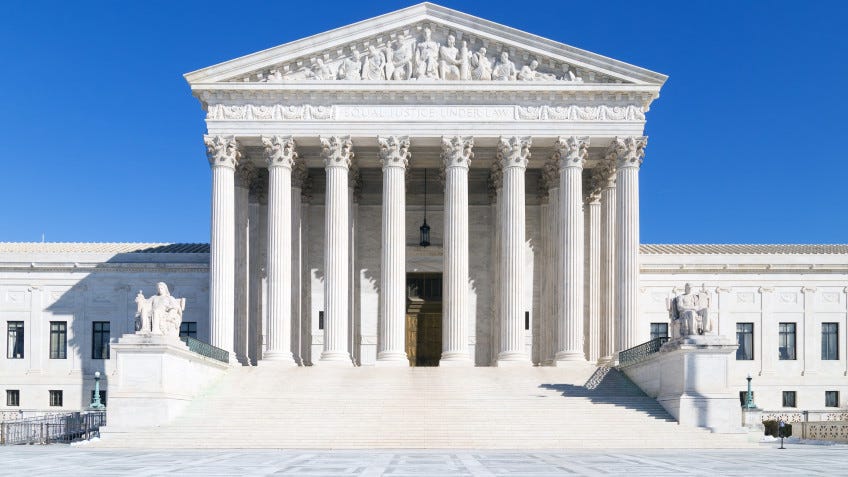
The U.S. Supreme Court has temporarily blocked a lower-court order requiring the Federal Communications Commission (FCC) to act quickly on a challenge to its political advertising policy, escalating a legal battle over who qualifies for discounted broadcast campaign rates ahead of the November 3, 2026, midterm elections.
Chief Justice John Roberts issued an administrative stay on October 8 after the FCC and Republican campaign committees sought emergency relief. The move temporarily pauses the lower court’s deadline while the justices consider the dispute; it is not a final ruling on the legality of the FCC policy
At the center of the case is the FCC’s “lowest unit charge” policy, which requires broadcasters to offer legally qualified political candidates their lowest rates for comparable advertising during specified periods before elections.
In March 2026, the FCC’s Media Bureau issued guidance extending those discounted rates to political party committees and certain joint fundraising committees. The change could allow party organizations to purchase television and radio advertising at lower prices during the critical weeks before Election Day.
Four Democratic candidates challenged the policy, arguing that federal law reserves the special rates for candidates themselves—not political parties or fundraising committees whose spending cannot legally be treated as spending by or on behalf of a candidate.
The challengers include Roy Cooper, the Democratic nominee for North Carolina’s open U.S. Senate seat; Georgia Sen. Jon Ossoff; former Ohio senator and current Senate candidate Sherrod Brown; and Michigan U.S. Rep. Kristen McDonald Rivet. <Cite refs={[“turn498664search0”,“turn498664news1”]} />
FCC Seeks Emergency Intervention
The latest dispute intensified after a divided panel of the 4th U.S. Circuit Court of Appeals ordered the FCC on October 7 to issue a final decision on the Democrats’ administrative challenge by noon on October 9.
The FCC, represented by Solicitor General John Sauer, asked the Supreme Court to block that order. Sauer argued that the appellate court had improperly intervened in the agency’s review process and imposed an unreasonable deadline during an election season.
In its filing, the government also argued that the lower court’s order could disrupt political advertising arrangements at a time when campaigns are competing for limited broadcast airtime.
The Supreme Court’s temporary intervention gives the justices additional time to consider the government’s request. <Cite refs={[“turn498664search0”,“turn498664search7”]} />
Why the Fourth Circuit Challenged the FCC
The 4th Circuit’s majority accused the FCC of delaying its review in a way that could prevent the Democratic candidates from obtaining meaningful judicial review before the election.
The judges supporting the order argued that the agency’s guidance expanded discounted advertising privileges beyond what Congress authorized. They maintained that the statutory language gives candidates a right to the lowest unit charge but does not automatically extend that benefit to political parties and joint fundraising committees.
The dissenting judge took a different view, warning that forcing the agency to act on an accelerated timetable could interfere with its decision-making process and disrupt campaign-finance rules close to Election Day.
The dispute therefore involves both the interpretation of federal election-advertising law and the boundaries of judicial authority over an agency’s pending administrative review. <Cite refs={[“turn498664search0”,“turn498664search7”]} />
The Supreme Court Has Already Intervened Once
This is not the first time the Supreme Court has stepped into the case.
On September 4, the justices voted 8–1 to block an earlier 4th Circuit ruling that had prevented the FCC’s guidance from taking effect. The majority reasoned that the Democratic candidates had challenged the policy before the FCC completed its own review, raising questions about whether the appellate court had jurisdiction to intervene at that stage.
The court also cited the potential harm to Republican party committees, which argued that broadcasters were withdrawing favorable rates following the lower court’s ruling. The committees said paying higher advertising costs could impair their ability to reach voters in the final weeks of the campaign.
Justice Ketanji Brown Jackson dissented from that earlier decision, arguing that the candidates were likely to succeed on their position that the 4th Circuit had jurisdiction.
The latest administrative stay adds another procedural turn to the case, but does not settle the underlying question of which political organizations are legally entitled to discounted broadcast rates. <Cite refs={[“turn498664news1”,“turn498664search0”]} />
Millions of Dollars in Campaign Spending at Stake
The case carries financial implications for both parties ahead of the November 3 midterm elections.
Federal Election Commission disclosures cited in Reuters reporting show that national Republican committees exceeded the former limits on coordinated party-candidate spending by more than $48 million after the Supreme Court’s separate June decision striking down those restrictions. Democratic committees also exceeded the previous limits, but by less than $4 million.
At the end of August, the three major national Republican committees reported approximately $233 million in cash, compared with about $130 million held by their Democratic counterparts, which also reported nearly $18 million in debt.
The advertising-rate dispute is separate from the June campaign-finance decision, but the two developments together have increased the importance of how party committees can finance and purchase campaign advertising. <Cite refs={[“turn498664news1”,“turn498664search0”]} />
What Happens Next?
The Supreme Court has temporarily paused the lower court’s deadline while it considers the FCC’s emergency application. Chief Justice Roberts directed the Democratic challengers to respond to the filing by Saturday.
The immediate question is whether the Supreme Court will keep the stay in place while the FCC completes its administrative review. The broader dispute over the legality of extending candidate-level discounted rates to political parties remains unresolved.
With Election Day approaching, the timing matters: a final decision could affect the advertising costs and campaign strategies of political committees seeking to reach voters through television and radio.
For now, the temporary stay preserves the existing position while the legal fight continues. It should not be interpreted as a final Supreme Court endorsement of the FCC’s policy on the merits. <Cite refs={[“turn498664news1”,“turn498664search7”]} />