

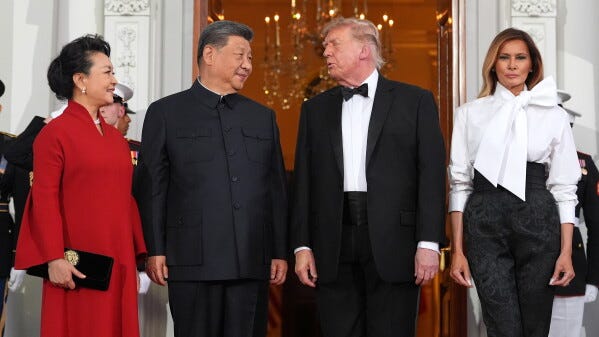
President Donald Trump guided Chinese President Xi Jinping through the National Archives on Friday, showing off the founding documents of American democracy in a symbolic conclusion to the Chinese leader’s highly publicized state visit to Washington.
The brief tour, which featured up-close views of the Declaration of Independence, the U.S. Constitution, and the Bill of Rights, served as the final stop of a three-day diplomatic trip that analysts noted was heavy on grand ceremony but distinctly light on substantive policy agreements.
The visit comes as the United States celebrates the 250th anniversary of its founding. Trump told reporters he wanted to show the leader of the world’s most powerful communist country “some of the greatest treasures of that proud history”.
Pomp and Protests
The atmosphere surrounding the summit was a study in contrasts.
Inside the White House grounds, the Trump administration rolled out the red carpet, treating Xi and his wife, Peng Liyuan, to tea, a candlelit black-tie state dinner attended by tech industry titans, and a personal tour of the president’s new 100-foot granite helicopter landing pad. The administration heavily emphasized its commitment to maintaining harmony between the globe’s two largest economies.
Meanwhile, just outside the gates at Lafayette Park, demonstrators maintained a near-constant presence throughout the three-day affair. Loudspeakers broadcasted the voices of protesters pushing for a range of causes, including religious autonomy in Tibet, greater freedoms in Hong Kong and Xinjiang, and demands to keep the Chinese military out of self-governed Taiwan.
Looking Ahead to November
Behind closed doors, the two leaders held a 90-minute private meeting on Thursday.
While the White House declined to release specific details of the private talks, the Chinese government’s official readout indicated the discussions focused heavily on regional security flashpoints, including the Middle East, the ongoing war in Ukraine, and tensions on the Korean Peninsula. Noticeably absent from the public statements were any major breakthroughs regarding pressing bilateral issues like trade tariffs or artificial intelligence safety frameworks.
Despite the lack of concrete deliverables, both sides appeared eager to keep diplomatic channels open. The leaders are currently scheduled to meet again in November at the Asia-Pacific Economic Cooperation (APEC) summit in Shenzhen, China.